This Website Is Still Under Development! So Some Things Might Not Work
We are creating something AWESOME!!!


Spiritual Wisdom · Hindu Tradition · Sacred Objects
The Spiritual Meaning
The Spiritual Meaning
of Khadau
How a simple pair of wooden sandals became one of the most sacred symbols in Hindu spiritual life — and why sages have worn them for millennia.
Scroll
In the stillness of ancient ashrams and the rustling forest hermitages of sages, one sound has echoed through the ages — the quiet, rhythmic knock of wooden sandals on the earth. This is the khadau: simple, unassuming, and yet one of the most spiritually charged objects in all of Hindu tradition.
Known also as charan paduka, these wooden sandals are more than footwear. They are a living symbol — of humility before the divine, of detachment from worldly comfort, of the guru’s grace, and of the eternal connection between a seeker and the sacred ground beneath their feet.
What is Known as Khadau?
Khadau (खड़ाऊँ) refers to a traditional Indian wooden sandal, typically carved from a single piece of wood — most commonly teak, sheesham (rosewood), sandalwood, or neem. The design is remarkably elemental: a flat wooden sole with a single raised knob or post that fits between the big toe and the second toe, allowing the foot to grip the sandal without any straps or buckles.
The Sanskrit term “paduka” (पादुका) is closely related — a compound of “pada” (foot) and the diminutive suffix “ka.” In spiritual contexts, both words are used interchangeably, though “khadau” is the more colloquial Hindi usage, while “paduka” carries a more classical and devotional connotation.
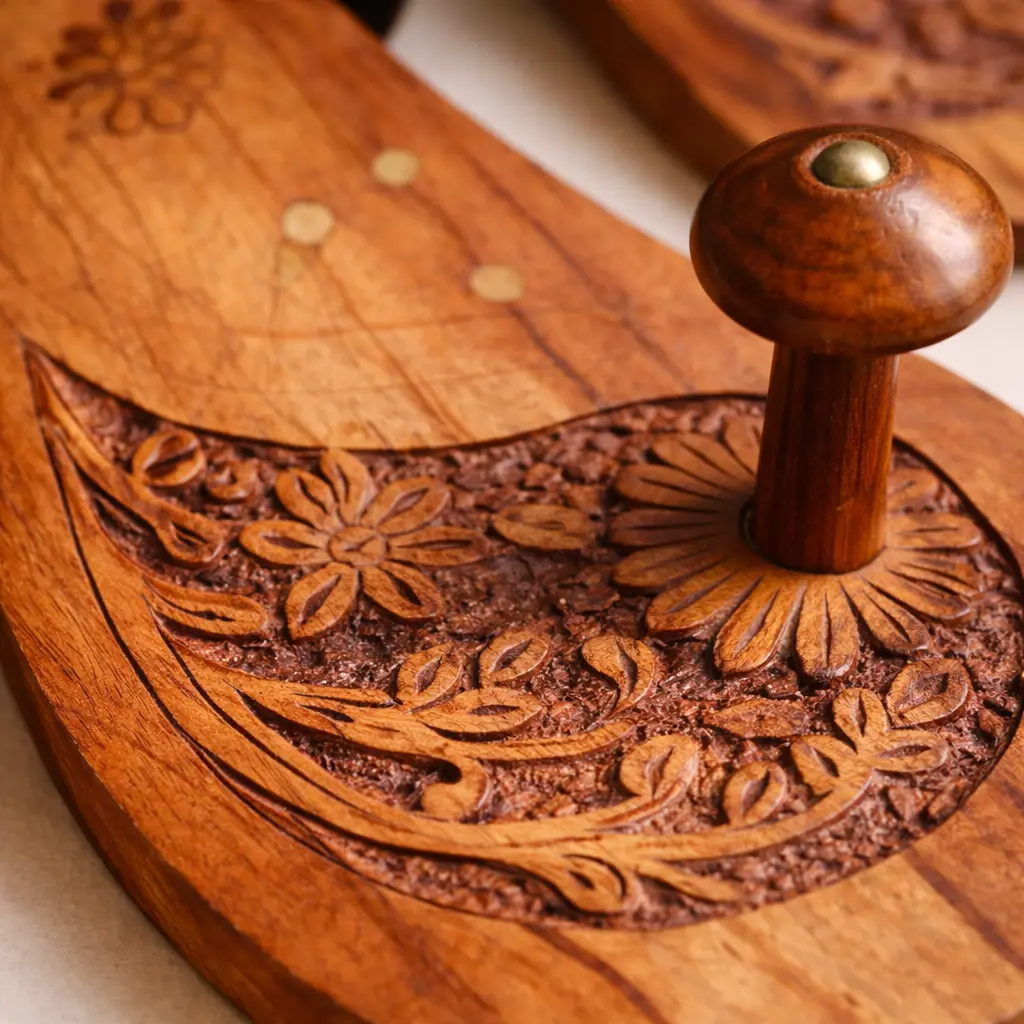
In their most ornate forms, khadau are decorated with intricate carvings, inlaid with brass, copper, silver, or even semi-precious stones. In their simplest forms, they are nothing more than a flat plank of wood with a toe knob — yet it is precisely this simplicity that carries their deepest spiritual resonance.
What is the Meaning of Khadau?
Humility and Detachment
At the heart of the khadau’s spiritual meaning lies a profound paradox: these wooden sandals, worn by the lowliest of ascetics and the highest of sages alike, represent the renunciation of material comfort. The choice to wear a simple piece of carved wood instead of soft, padded leather or silk slippers is a deliberate statement — a declaration that the wearer has chosen the path of simplicity, of vairagya (dispassion), and of inner richness over outer luxury.
For saints and sages across the Vedic tradition, Jainism, and Buddhism, the khadau served as a daily reminder that spiritual progress is not measured by comfort, but by the depth of one’s inner surrender. To wear them is to align oneself with the earth, not to rise above it.
Grounding and the Earth Connection
The wooden sole of the khadau maintains a direct connection between the foot and the earth. Unlike modern rubber-soled shoes that insulate the body from the ground, the khadau — being natural wood — allows a degree of energetic connection with the earth’s subtle forces.
In yogic and Ayurvedic thought, the earth element (prithvi tattva) is associated with stability, nourishment, and groundedness. Wearing wooden sandals is believed to help the practitioner stay energetically rooted even as they aspire toward higher states of consciousness — a reminder that spiritual elevation does not mean abandoning earthly responsibilities, but transcending them with full awareness.
Forgive me, Mother Earth, the sin of injury — the violence I do by placing my feet upon you this morning.
Traditional Brahmin prayer, spoken while wearing padukaNon-Violence and Reverence for Life
One of the lesser-known but deeply meaningful aspects of the khadau’s design is its role in the practice of ahimsa (non-violence). The narrow, slightly raised stilts of the traditional paduka design were specifically intended to minimize the contact between the sandal and the ground, thereby reducing the risk of accidentally stepping upon insects or small vegetation.
This design was particularly valued among Jain mendicants, Brahmin priests, and Vaishnava saints for whom non-violence toward all living beings was a fundamental spiritual vow. The very structure of the khadau thus embodies the ethic of compassion and reverence for life in its most practical form.
Key Spiritual Meanings of Khadau
- Humility — renouncing material comfort and pride of position
- Grounding — maintaining connection with earth’s energies while pursuing higher states
- Ahimsa — the design protects insects and vegetation underfoot
- Guru Bhakti — wearing or worshipping the guru’s khadau as a form of devotion
- Divine Presence — paduka as a representation of the feet of gods and saints
- Detachment — a symbolic break from the sensory pleasures of worldly life
- Spiritual Authority — once worn by saints, khadau carry their blessings
What is the Spiritual Meaning of Khadau?
The spiritual meaning of khadau runs deep into the roots of Hindu devotional culture. It is simultaneously a symbol of surrender, a vessel of divine grace, and a daily practice of humility. No story captures this more powerfully than the celebrated episode from the Ramayana that transformed paduka from footwear into a throne of the divine.
Sacred Story from the Ramayana
Bharata and the Golden Sandals
When Lord Rama was exiled to the forest for fourteen years, his devoted younger brother Bharata was devastated. Refusing to sit upon the throne of Ayodhya in his brother’s absence, Bharata went to the forest to beg Rama to return and reclaim his rightful place as king.
Rama, bound by his father’s word, declined. In response, Bharata made a remarkable request: he asked for Rama’s khadau — his wooden sandals. With immense reverence, he placed the sandals upon his own head as a mark of complete surrender and obedience to his elder brother.
Bharata then returned to Ayodhya and installed Lord Rama’s padukas upon the royal throne. For fourteen years, he ruled the entire kingdom not in his own name, but as a servant — as the regent of Rama’s khadau. He himself lived as an ascetic in a simple hut outside the capital, waiting for his brother’s return.
In this extraordinary act, Bharata demonstrated the highest form of devotion: that true love surrenders all ego, and that the symbol of one’s beloved — even a pair of wooden sandals — can become the living representative of divine will itself.
This episode established khadau not merely as footwear, but as a vessel of spiritual authority and divine presence. The feet of a divine being or a realized saint are understood in Hindu tradition to be the most sacred part of their form — and thus the khadau, which holds and protects those feet, becomes imbued with the same sacredness.
Why Do Saints Wear Khadau?
In the guru-shishya (teacher-disciple) tradition of India, there is perhaps no object more venerated than the khadau or paduka of one’s spiritual master. The practice of guru paduka worship (Guru Paduka Puja) is one of the most intimate expressions of devotion in the spiritual path.
The feet of the guru are considered the point of transmission — where divine grace flows most directly from the realized master to the sincere seeker. The khadau, having held those sacred feet, is thus believed to carry the guru’s energy, blessings, and the accumulated spiritual power of their sadhana (spiritual practice).
In ashrams and temples across India, the khadau of saints and sages are placed on altars and worshipped as the deity itself. The famous Pandharpur Yatra — one of the most celebrated pilgrimages in Maharashtra — involves devotees carrying the padukas of saints Dnyaneshwar and Tukaram in a silver palanquin across hundreds of kilometers to the temple of Lord Vithoba, chanting and singing all the way.
The guru’s feet are the highest altar. The khadau that has touched those feet carries the warmth of liberation itself.
Ancient Vedantic TeachingEven the sight of the guru’s khadau is considered auspicious. Disciples bow before them, touch them to their foreheads, and keep them in their homes as objects of daily veneration. The mantra “Guru Paduka Stotram” — a hymn of praise to the sacred sandals of the guru — is recited in many Vedantic lineages as part of morning prayer.
Khadau of the Gods: Divine Footprints
The spiritual significance of khadau extends far beyond living masters into the realm of the divine itself. Entire temples across the Indian subcontinent are dedicated not to the full form of a deity, but specifically to their divine footprints — the charan paduka of the gods.
The Vishnupad Mandir in Gaya, Bihar, is among the most famous: the central object of worship is not a conventional idol, but the footprint of Lord Vishnu preserved in stone, believed to be 40 centimeters in length. Similarly, the footprints of the Buddha are venerated at Bodh Gaya under the Bodhi Tree — a tradition that spread across all of Asia as Buddhism traveled beyond India’s shores.
In Vaishnava temples, the khadau or paduka of Lord Vishnu, Lord Krishna, and Lord Rama are central to the daily ritual of sringara (divine adornment). The deity’s sandals are placed, removed, cleaned, and offered flowers and sandalwood paste as part of the loving service (seva) that forms the heart of devotional worship.
Famous Paduka Temples & Pilgrimage Sites
- Vishnupad Mandir, Gaya — Lord Vishnu’s divine footprint in stone
- Bodh Gaya, Bihar — Buddha’s footprints beneath the Bodhi Tree
- Pandharpur, Maharashtra — Padukas of saints Dnyaneshwar and Tukaram venerated in the annual Vari pilgrimage
- Rameshwaram, Tamil Nadu — Footprints of Lord Rama venerated at the Gandhamadhana hill
- Vrindavan — Temples preserving the footprints of Lord Krishna
The Natural Wisdom: Health Benefits of Khadau
The spiritual significance of khadau is inseparable from its relationship to nature. Traditional Indian medicine (Ayurveda) and yogic science both recognize that the materials and practices we surround ourselves with profoundly affect our inner states.
Wood is a living material, and different woods carry different qualities. Sandalwood khadau are prized for their cooling, calming nature — sandalwood is associated with sattvic (pure, harmonious) qualities that support meditation and spiritual clarity. Neem wood carries antibacterial and purifying properties. Sheesham (rosewood) is valued for its durability and warm, grounding energy.
Walking in wooden sandals naturally stimulates the acupressure points on the soles of the feet. The toe knob engages the reflex zones associated with the spine and nervous system. Modern reflexology and traditional Indian foot massage (pada abhyanga) both recognize the sole of the foot as a map of the body — and the gentle pressure of the khadau’s design may well support the flow of prana (life force) through the body’s energy channels (nadis).
Furthermore, unlike synthetic materials, wood does not trap heat or accumulate static electricity in the way that rubber or plastic do. The traditional wisdom of choosing natural materials for contact with the body reflects an intuitive understanding of the body’s energetic sensitivity.
Khadau in the Modern World
In an era of mass production, synthetic materials, and hyper-speed living, the humble khadau stands as a quiet but powerful counterpoint. Its resurgence in popularity among yoga practitioners, spiritual seekers, and eco-conscious individuals around the world points to a deeper longing: for simplicity, for natural living, and for objects that carry meaning beyond mere utility.
Many contemporary yoga teachers and spiritual practitioners choose to wear khadau during their practice or meditation as a way of honoring the ancient traditions from which their paths descend. The sandals serve as a grounding ritual — a physical reminder, at the very start of each step, of the values they are trying to embody.
Artisans in Varanasi, Vrindavan, Mathura, and across Rajasthan continue the centuries-old tradition of hand-carving khadau, often inlaying them with intricate brass or silver work. These are not merely craft objects — they are living links in an unbroken chain of sacred craftsmanship stretching back thousands of years.
Whether worn during morning prayers, gifted to a beloved teacher, placed reverently on a home altar, or carried in pilgrimage, khadau continue to carry the same essential message they have always carried: that the path to the sacred is walked not in pride, but in humility — not in haste, but in mindful, deliberate steps upon the holy earth.
Conclusion: Sacred Footsteps on the Path
The spiritual meaning of khadau cannot be captured in a single word or concept. It is layered — like the rings of the tree from which it is carved — with meanings that deepen the more one contemplates them. It is humility and grace. It is the guru’s blessing and the deity’s presence. It is the practitioner’s commitment to ahimsa, to simplicity, to connection with the earth, and to the ancient lineage of seekers who walked this same path before.
When Bharata placed Rama’s khadau upon the throne of Ayodhya, he taught the world something timeless: that a symbol, when imbued with love, devotion, and surrender, can carry the full presence of the divine. The khadau is that symbol — ancient, simple, and inexhaustibly sacred.
To hold a pair of khadau in your hands is to hold thousands of years of wisdom. To wear them is to walk, however humbly, in the footsteps of the saints.