This Website Is Still Under Development! So Some Things Might Not Work
We are creating something AWESOME!!!

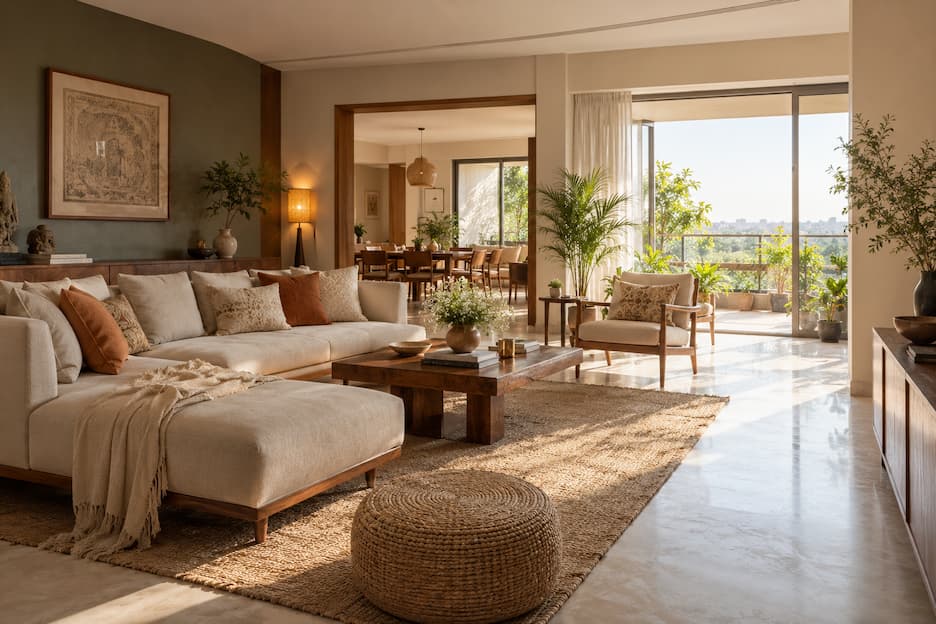

If you want to bring Vastu into your home, you do not need to start by moving walls, changing rooms, or buying a collection of so-called Vastu remedies. The most useful place to begin is with the fundamentals: the direction of the home, the main entrance, room placement, natural light, ventilation, open space, and the way the house is actually used.
If you are building a new house, you have more freedom to apply these principles from the beginning. If you already live in a house or apartment, the approach needs to be different. You cannot always move a kitchen or change the orientation of a bathroom, and you do not necessarily need to.
The goal should be to understand the principles and then decide which ones are practical for your home.
Key Takeaways
- The main entrance, northeast zone, Brahmasthan (Central Zone), and placement of major rooms are among the most important areas to consider in Vastu.
- Southeast is traditionally associated with Agni and is therefore preferred for kitchens, while southwest is associated with stability and heavier spaces.
- The northeast is generally kept light, clean, open, and free from heavy storage or toilets.
- Sleeping direction, cooking direction, staircase placement, mirrors, colours, and water elements can also be considered as part of a home’s Vastu.
- Existing homes do not always require structural changes; furniture placement, decluttering, colours, lighting, and appropriate Vastu remedies can address many practical concerns.
Direction matters in Vastu, but the facing of a house alone does not determine whether its layout is favourable.
Understanding the Vastu Directions and Five Elements
Before applying individual Vastu tips, it helps to understand the basic framework behind them.
Vastu divides the home according to the eight principal directions – north, northeast, east, southeast, south, southwest, west, and northwest – along with the central Brahmasthan.
Each direction has traditionally been associated with particular qualities and deities, while the five elements – Earth, Water, Fire, Air, and Space – are used to understand the balance within the home.
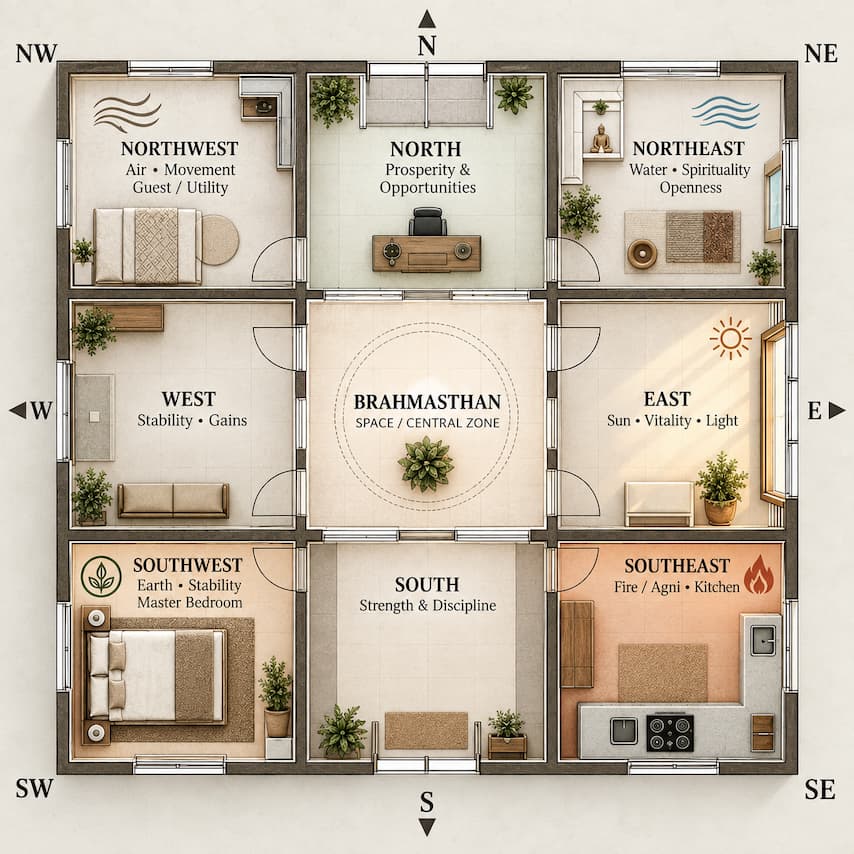
A simplified way of looking at these associations is:
| Direction | Traditional Association | Common Vastu Use |
|---|---|---|
| Northeast | Water and spiritual energy | Pooja, meditation, open space |
| East | Sun and vitality | Entrance, windows, living areas |
| Southeast | Fire / Agni | Kitchen |
| South | Strength and discipline | Supporting spaces |
| Southwest | Earth and stability | Master bedroom, heavy storage |
| West | Stability and gains | Dining, storage, supporting spaces |
| Northwest | Air and movement | Guest bedroom, bathrooms, utility |
| North | Prosperity and opportunities | Entrance, living, workspace |
| Centre | Space / Brahmasthan | Open circulation area |
These associations are a starting framework, not a substitute for evaluating the actual floor plan.
What Makes a Home Vastu-Friendly?
Vastu Shastra is a traditional Indian system of architecture and spatial planning that considers the relationship between the built environment, directions, the five elements, and the way people use a space.
Rather than looking at one isolated feature, traditional Vastu considers the home as a whole. The entrance, rooms, circulation, open spaces, natural light, colours, objects, and even the weight and placement of furniture can all play a role.
This is also why simply having a north-facing or east-facing house does not automatically make a home Vastu-friendly. The entrance, internal layout, kitchen, bedrooms, centre of the home, and other elements need to be considered together.
With that in mind, here are ten Vastu principles worth considering.
#1) Pay Attention to the Main Entrance
The main entrance is one of the most important considerations in Vastu because it is traditionally regarded as the primary point through which energy enters the home.
East, north, and northeast are commonly considered favourable zones for entrances, although Vastu also considers the exact position of the door within a direction. This is where the traditional concept of padas becomes relevant.
Each side of a Vastu plan can be divided into sections or padas, and different entrance positions are given different significance. Therefore, simply saying that “a north-facing entrance is good” is an oversimplification.
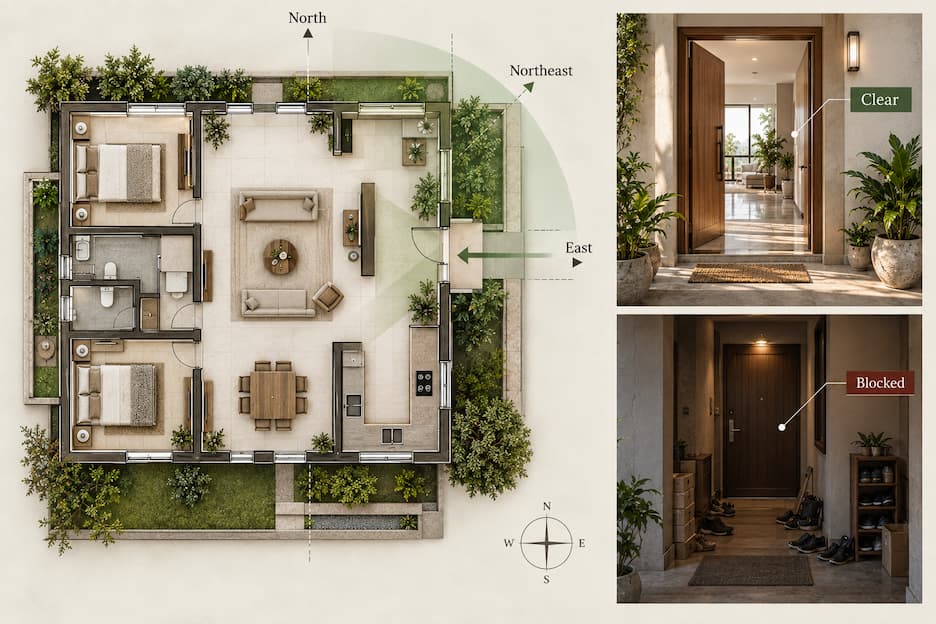
The entrance should ideally be:
- Clearly defined and easy to identify
- Clean and free from clutter
- Well lit
- Larger and more welcoming than internal doors where appropriate
- Free from direct obstructions
- In good condition, without a damaged or constantly sticking door
- Supported by a clean and pleasant threshold
A shoe rack should preferably not dominate the entrance, and broken items, unused footwear, garbage, or excessive storage should not accumulate around the doorway.
A small nameplate, suitable lighting, plants, or traditional decorative elements can be used to make the entrance feel welcoming without overcrowding it.
If you are building a new home
Consider the entrance during the planning stage rather than trying to correct it later. The plot orientation, road position, floor plan, and placement of rooms should all be considered together.
If your home is already built
You do not necessarily need to relocate your entrance. Keeping the doorway clean, well-lit, attractive, and free from obstructions is a simple way to improve the entrance area.
#2) Keep the Northeast Light, Clean and Open
The northeast, traditionally known as the Ishanya corner, is one of the most significant zones in Vastu.
It is associated with water, spiritual energy, clarity, and auspiciousness. Because of this, the northeast is generally kept light, clean, open, and less burdened by heavy structures.
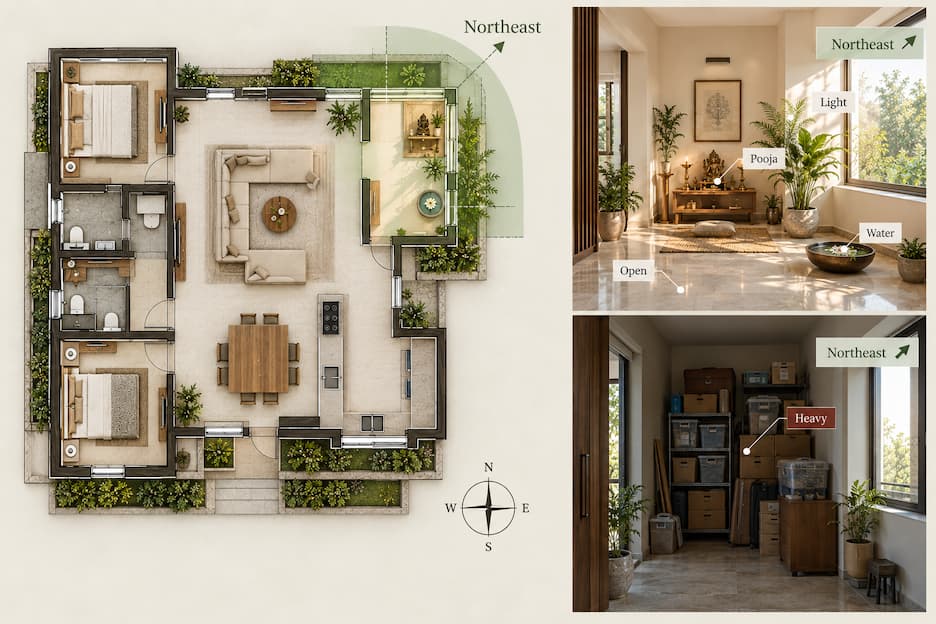
Ideally, avoid placing:
- Heavy wardrobes
- Large storage cabinets
- Excessive clutter
- Toilets
- Large electrical equipment
- Unnecessary construction
- Very heavy furniture
A pooja room, meditation area, window, garden, courtyard, or other relatively open feature can work well in this zone depending on the home’s design.
The northeast is also traditionally preferred for water-related elements. However, a water feature should never be added simply for decoration if it creates dampness, maintenance problems, or stagnant water.
For an existing home
If the northeast already contains furniture or storage, you do not necessarily need to rebuild the room. Start by removing unnecessary objects, reducing visual weight, improving natural light, and keeping the area clean and open.
#3) Place the Kitchen in the Southeast With the Fire Element in Mind
The kitchen is closely connected with Agni, the fire element, and its placement is therefore particularly important in Vastu.
The southeast is traditionally considered the ideal direction for a kitchen because it is associated with the fire element. The northwest is also considered an acceptable alternative in many Vastu traditions when a southeast kitchen is not possible.
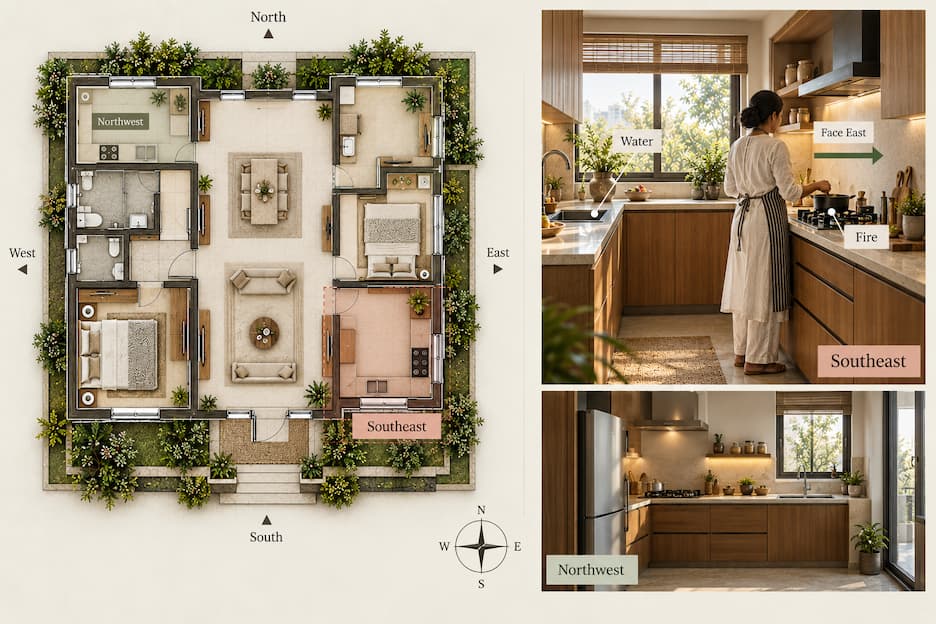
Beyond the room itself, the placement of the stove is also considered important. Traditionally, cooking while facing east is preferred, although the exact arrangement should depend on the kitchen’s actual layout and usability.
The kitchen should also remain clean, organised, and well ventilated. Avoid allowing the cooking area to become excessively crowded with appliances, storage, and unused items.
If your kitchen is already in another direction
Do not assume that the entire home is automatically unsuitable. Vastu is best considered as a collection of principles rather than a single pass-or-fail test. Where structural changes are impractical, homeowners can focus on cleanliness, ventilation, organisation, cooking direction, and other manageable aspects.
#4) Use the Southwest for Stability and Heavy Spaces Like Master Bedroom
The southwest is traditionally associated with the Earth element, stability, grounding, and strength.
For this reason, the southwest is generally considered suitable for the master bedroom and other heavier elements of the home.
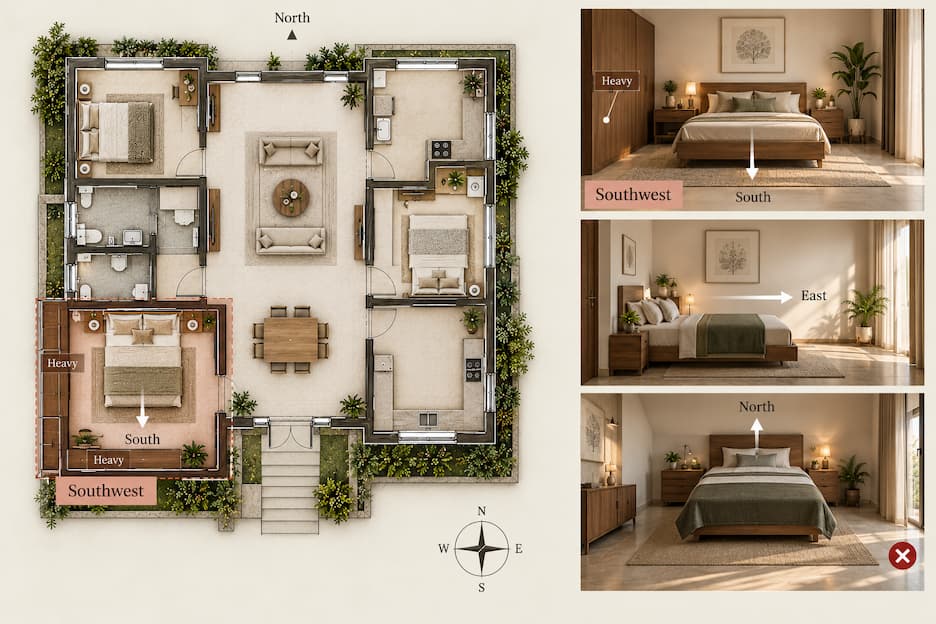
A master bedroom in the southwest can be supported by:
- A solid bed
- Heavy wardrobes toward the south or west
- Earthy and grounded colours
- A stable furniture arrangement
- Minimal unnecessary movement through the room
The bed itself is traditionally positioned so that the sleeper’s head is toward the south or east, while sleeping with the head toward the north is generally avoided in Vastu.
For couples, the master bedroom is usually preferred over bedrooms in the northeast because the southwest is considered a more stable zone.
The room should still have adequate ventilation and natural light. Vastu should not be used as a reason to create a dark or uncomfortable bedroom.
#5) Give the Pooja Room a Dedicated and Respectful Place
The pooja room is one of the spaces where Vastu principles and Indian household traditions come together particularly strongly.
The northeast is traditionally considered the most auspicious location for a pooja room, with east and north also commonly preferred.
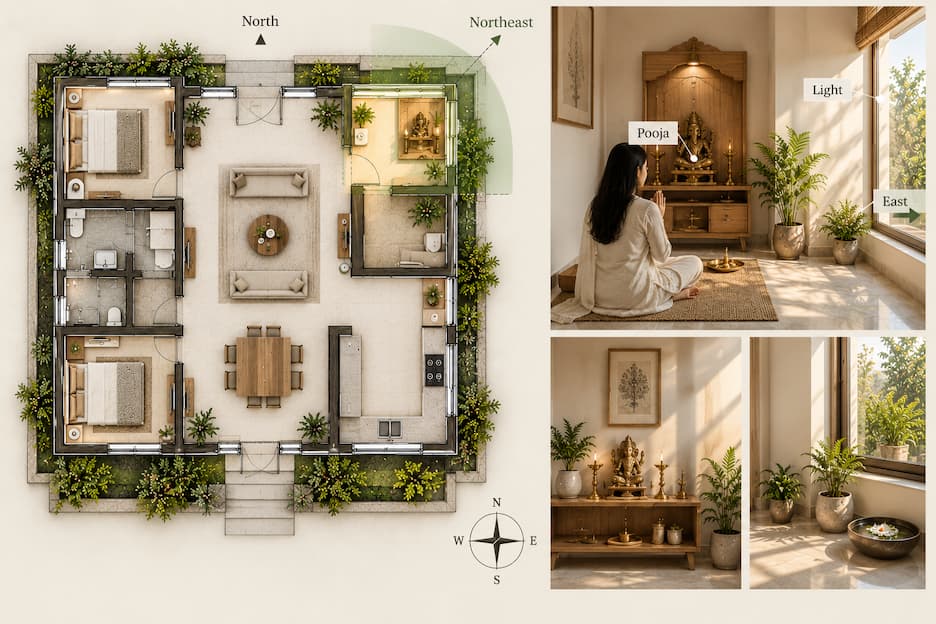
Ideally, the pooja space should be:
- Clean and peaceful
- Away from toilets
- Away from excessive household clutter
- Separate from shoes and footwear
- Well ventilated
- Naturally lit where possible
The person praying can traditionally face east or north, depending on the arrangement of the idols and the room.
If you have a dedicated pooja room, avoid using it as additional storage. A prayer space filled with unrelated boxes, documents, cleaning supplies, and household items loses the sense of purpose that the space is traditionally meant to have.
#6) Keep the Brahmasthan (Central Zone) as Open, Light and Uncluttered
The Brahmasthan refers to the central zone of the home and is traditionally considered its energetic centre.
In traditional Vastu planning, this area is often left open or relatively unobstructed. The idea is to allow space and energy to move freely through the centre of the house.
In a modern apartment, completely emptying the centre is rarely realistic. Instead, avoid turning this area into the heaviest storage zone in the house.
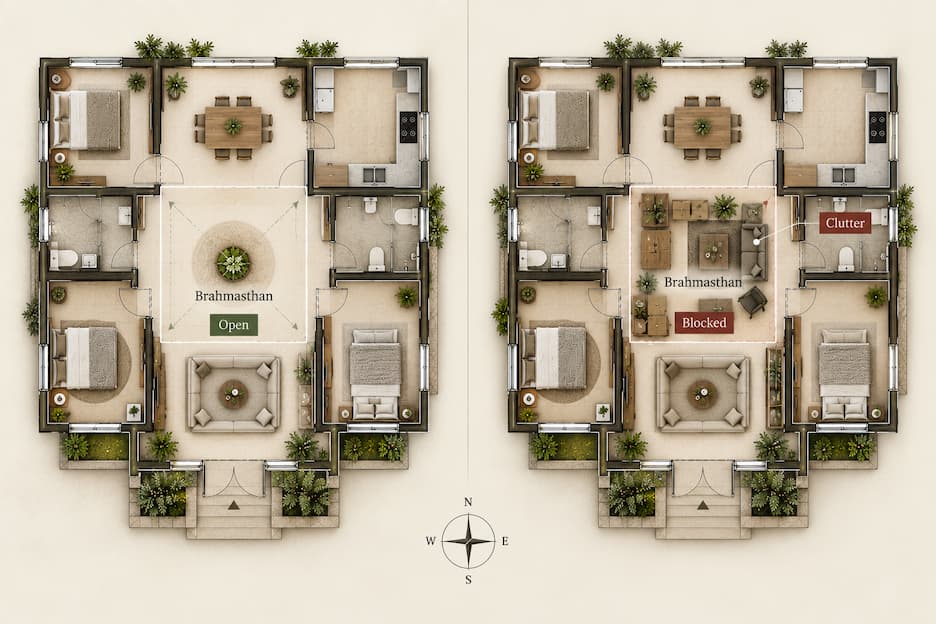
Try to avoid:
- Large wardrobes in the centre
- Tall storage structures
- Heavy clutter
- Unused boxes
- Unnecessary partitions
- Furniture that blocks the main circulation path
A dining table or living furniture may naturally occupy part of the central area in a modern home, and this does not mean the entire house has poor Vastu.
The practical objective is to keep the centre visually lighter and functionally accessible.
For apartments with limited space, a dedicated pooja cabinet or thoughtfully planned prayer corner can still work.
#7) Use Natural Light, Windows and Airflow to Support Vastu
Sunlight and fresh air have always been important considerations in traditional Indian architecture, and Vastu places particular emphasis on openings and directional qualities.
The east is associated with the rising sun and is traditionally considered an important direction for receiving morning light. North is also generally valued for openings and natural illumination.
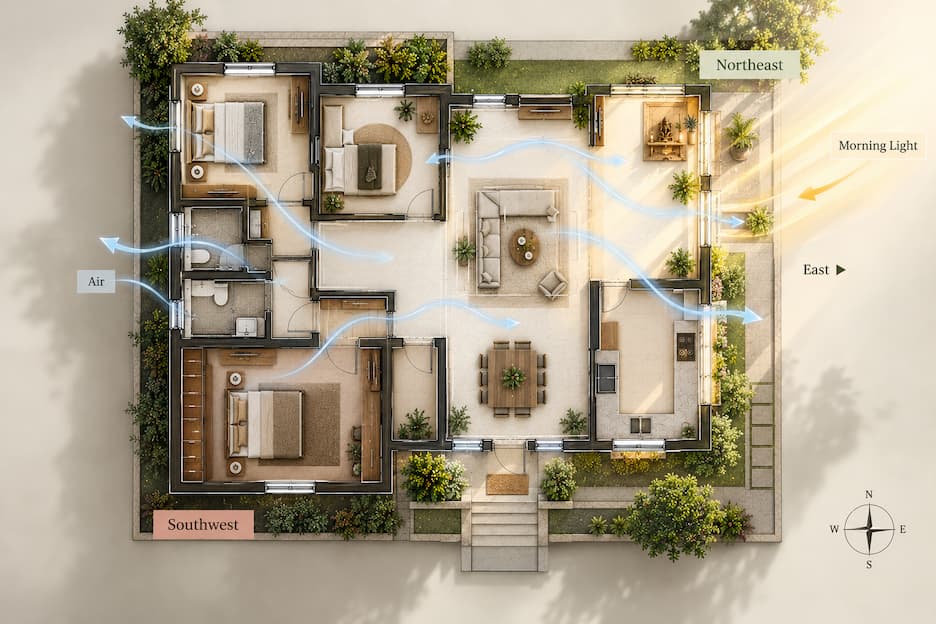
Where possible:
- Keep east and north windows unobstructed
- Allow morning sunlight into the home
- Avoid permanently blocking windows with heavy furniture
- Maintain cross ventilation
- Keep rooms from becoming excessively dark
- Use balconies and open spaces intelligently
The southwest can generally carry more visual and structural weight, while the northeast and east benefit from openness and lightness.
This principle is particularly valuable because good daylight and ventilation improve the actual experience of living in the home, regardless of whether someone follows Vastu.
#8) Be Careful With Toilets, Bathrooms, Staircases and Water
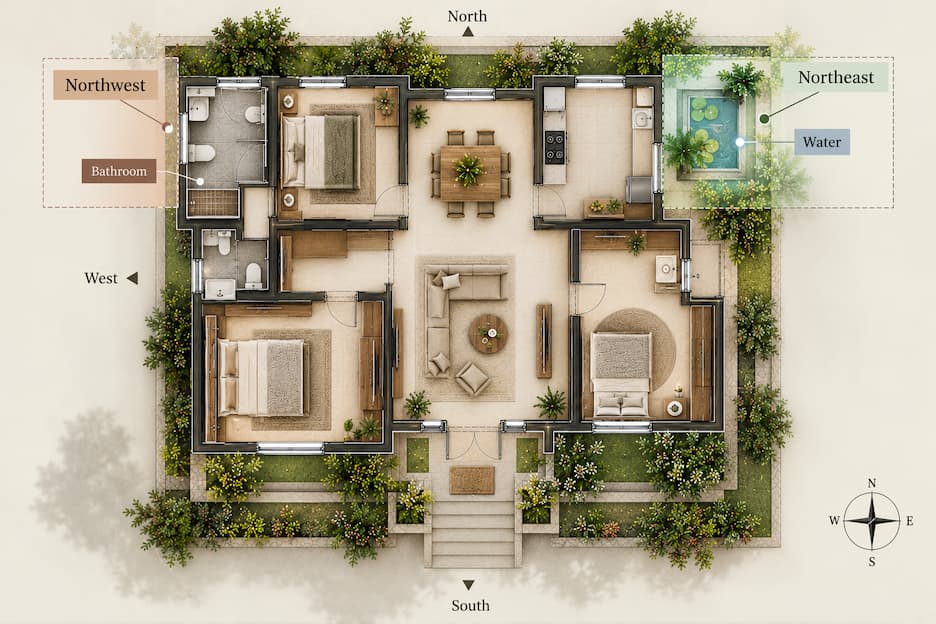
Some of the most commonly discussed Vastu concerns involve bathrooms, toilets, staircases, and water elements.
Bathrooms and toilets
Northwest, west, and certain southern zones are commonly considered more appropriate for bathrooms and toilets, while the northeast is traditionally avoided for toilets because of the importance attached to this direction.
Where possible, keep bathroom spaces well ventilated, dry, clean, and properly maintained.
Staircases
Staircases are generally treated as heavier elements and are therefore traditionally preferred toward the south, west, or southwest portions of the house.
A staircase in the exact centre or northeast is often avoided in traditional Vastu planning.
When considering staircase direction, the traditional preference is generally for the staircase to rise in a clockwise direction.
Water elements
Water features such as fountains, aquariums, and decorative water bodies are traditionally associated with the north and northeast.
However, water should be clean and moving rather than stagnant. A neglected aquarium or constantly leaking fountain is not a positive addition simply because it has been placed in a traditionally favourable direction.
#9) Choose Colours, Mirrors and Décor According to the Space
Vastu also extends into the visual character of a home.
Different directions are traditionally associated with different elements, so colours can be selected to support the character of each zone.
For example, earthy shades can work well in southwest areas because they complement the traditional Earth association of that direction. Lighter shades can be used in the northeast to maintain a sense of openness, while warmer tones can be introduced carefully in fire-associated southeast spaces.
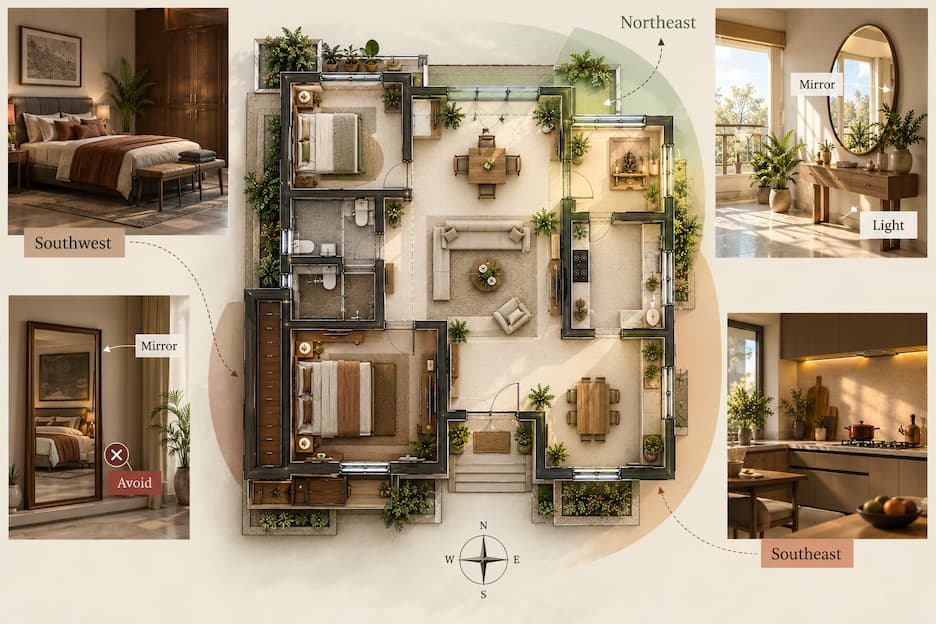
Mirrors require particular attention.
According to traditional Vastu, mirrors are believed to reflect and redirect energy. Because of this, they should not be placed casually wherever there is an empty wall.
Common practical guidelines include:
- Avoid placing a mirror directly opposite the bed
- Avoid using excessive mirrors in the bedroom
- Use mirrors where they can reflect natural light or an attractive view
- Keep mirrors clean and undamaged
- Avoid positioning mirrors so they reflect clutter or an unpleasant area
Décor should also have some intention behind it. A home does not need dozens of Vastu objects to become balanced.
#10) Declutter the Home and Keep Heavy Elements in the Right Zones
Clutter is one of the easiest Vastu concerns to address because it does not require construction work.
Traditional Vastu places importance on maintaining order and allowing different zones of the home to function properly. Unused belongings, broken objects, excessive storage, and blocked passages can make a space feel heavy and stagnant.
As a practical rule, heavier furniture and storage can generally be concentrated toward the south, west, and southwest, while the north, east, and northeast are kept comparatively lighter and more open.
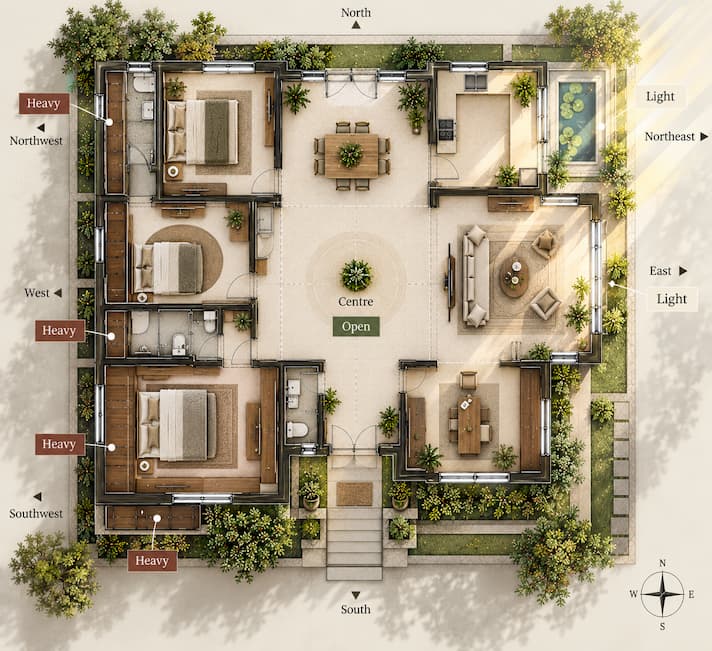
Pay particular attention to:
- The main entrance
- Northeast corner
- Centre of the home
- Under the bed
- Kitchen counters
- Balconies
- Staircases
- Storage corners
Do not confuse a Vastu-friendly home with an empty home. The objective is not minimalism for its own sake; it is to create a sense of balance between heavy and light areas.
What If Your Existing Home Does Not Follow Vastu?
This is one of the most important questions homeowners have, particularly when living in apartments.
You do not need to assume that your home is “bad” simply because one room is in a direction that differs from a traditional recommendation.
Instead, separate Vastu concerns into structural and non-structural changes.
Structural changes might involve moving a kitchen, toilet, staircase, or entrance. These should only be considered after understanding the complete plan and the cost involved.
Non-structural changes are much easier:
- Rearrange furniture
- Keep the northeast lighter
- Move heavy storage toward south or west
- Position the bed appropriately
- Adjust the direction of your study desk
- Keep the centre uncluttered
- Improve natural light
- Add suitable plants
- Use colours thoughtfully
- Remove broken objects
- Keep the entrance clean
- Use traditional remedies where appropriate
This approach is particularly useful for renters because many Vastu principles can be incorporated without making permanent alterations.
A Simple Vastu Checklist for Your Home
| Area | Traditional Vastu Guidance |
|---|---|
| Main entrance | North, east, and certain northeast positions are commonly preferred |
| Northeast | Keep light, clean, open and positive |
| Southeast | Preferred zone for kitchen and fire element |
| Southwest | Suitable for master bedroom and heavier elements |
| Pooja room | Northeast commonly preferred; east and north are alternatives |
| Brahmasthan | Keep central area relatively open and uncluttered |
| Kitchen stove | Face east while cooking where practical |
| Bed | Head traditionally toward south or east |
| Study desk | Face east or north |
| Heavy storage | Prefer south, west or southwest |
| Staircase | South, west or southwest commonly preferred |
| Toilets | Northwest, west and certain southern zones commonly considered |
| Water features | North and northeast traditionally preferred |
| Mirrors | Use thoughtfully; avoid directly opposite the bed |
| East and north windows | Keep open for light and airflow |
| Clutter | Minimise throughout the home, especially entrance and northeast |
How to Apply Vastu Without Renovating Your Home
If you are living in a rented apartment or an already-built house, there are still plenty of things you can do.
Begin with the entrance. Keep it clean, well lit, and free from unnecessary objects. Then look at the northeast and see whether it can be made lighter and less cluttered.
Next, examine the centre of the home. Remove unnecessary storage and make sure there is a comfortable path through the main living areas.
In the bedroom, check the bed position and avoid excessive clutter around or underneath it. In the kitchen, keep the cooking area clean and well ventilated and, where possible, consider the direction in which you face while cooking.
You can also make smaller changes through colour, lighting, plants, décor, and furniture placement. These changes are inexpensive, reversible, and far more practical than making major structural alterations to an existing home.
Is Vastu Necessary for a Good Home?
A home can be comfortable, beautiful, functional, and meaningful in many different ways. Vastu is one traditional framework that people choose to use when making decisions about their homes.
For families who value Indian traditions, Vastu can provide an additional way of thinking about orientation, room placement, elements, light, movement, and the atmosphere of a space. At the same time, practical considerations such as structural safety, ventilation, daylight, accessibility, privacy, and everyday functionality should never be ignored.
The best approach is often to bring the two together. Use Vastu principles where they make sense, while designing a home that genuinely works for the people who live in it.
Common Vastu Mistakes Homeowners Should Avoid
Mistake #1) Treating the house facing as the entire Vastu assessment
A north-facing house is not automatically better than a south-facing house, and the phrase “east-facing house” tells you very little about the complete Vastu of a home. The entrance location, room arrangement, centre, and elemental balance matter as well.
Mistake #2) Treating every rule as equally important
Not every Vastu recommendation carries the same weight. Entrance, orientation, major room placement, Brahmasthan, and elemental zones deserve more attention than minor decorative rules.
Mistake #3) Adding too many remedies
A home filled with pyramids, mirrors, crystals, symbols, and other remedies can quickly become visually chaotic.
Mistake #4) Making expensive changes without understanding the layout
Moving a kitchen or bathroom simply because an online article says it is in the wrong direction may not be practical or necessary. Never sacrifice ventilation, structural safety, natural light, accessibility, or comfortable movement simply to satisfy a minor Vastu recommendation.
Mistake #5) Ignoring the architecture
Vastu should complement the way a house actually works. Blocking windows, reducing ventilation, creating awkward circulation, or making a room uncomfortable simply to follow a rule defeats the purpose of creating a harmonious home.
Mistake #6) Following internet rules without checking the floor plan
Vastu is highly dependent on the actual orientation and arrangement of a property. A rule that makes sense for one floor plan may not apply in exactly the same way to another.
Final Thoughts
Vastu works best when you look at the home as a complete system rather than trying to memorise hundreds of individual rules.
Start with the fundamentals: understand the orientation of the property, assess the main entrance, keep the northeast light and open, use the southeast thoughtfully for fire-related functions, give the southwest enough stability and weight, and avoid making the Brahmasthan unnecessarily heavy.
Once these larger principles are addressed, you can move toward smaller details such as sleeping direction, cooking direction, colours, mirrors, plants, water features, furniture placement, and traditional remedies.
Most importantly, Vastu should help you create a home that feels balanced rather than anxious. The goal is not to constantly worry that one misplaced object will affect your life. It is to create a space that feels considered, harmonious, clean, comfortable, and aligned with the traditions you value.
A home is shaped by countless choices – from its orientation and layout to the materials, colours, and details that make it feel personal. At Vandanya, we explore these choices through practical ideas, thoughtful design, Vastu, and Indian-inspired living. Explore Vandanya for more guides and inspiration to help you make better decisions for the spaces you call home.
Frequently Asked Questions
Which direction is best for the main entrance?
North, east, and certain positions in the northeast are traditionally considered favourable. The exact placement of the entrance within the direction can also matter, which is why Vastu practitioners often assess the entrance using directional divisions or padas.
Which direction is best for the kitchen?
The southeast is traditionally considered the best location because it represents Agni, the fire element. Northwest is generally considered the next suitable option.
Which direction should I face while cooking?
Traditionally, facing east while cooking is preferred. The kitchen should therefore ideally be planned so that the stove allows this orientation without compromising functionality.
Which direction should I sleep with my head?
Vastu traditionally recommends sleeping with the head toward the south or east. Sleeping with the head toward the north is generally avoided.
Which direction is best for the master bedroom?
The southwest is traditionally considered the best location for the master bedroom because this zone is associated with stability, strength, and grounding.
Which direction is best for a pooja room?
The northeast is traditionally preferred for a pooja room, with east and north also considered suitable options.
What should not be kept in the northeast corner?
Heavy storage, excessive clutter, large bulky furniture, and toilets are traditionally avoided in the northeast. The area is generally kept light, clean, open, and spiritually positive.
Is a south-facing house bad according to Vastu?
No. A south-facing house is not automatically bad. Vastu considers the position of the entrance, internal rooms, Brahmasthan, elements, and other features before assessing the property as a whole.
Can Vastu be corrected without changing the structure?
Yes. Many aspects can be addressed through furniture placement, decluttering, colours, lighting, room usage, and traditional remedies. Structural issues may require a more detailed assessment before deciding whether any renovation is actually necessary.
Does Vastu really affect prosperity and health?
In traditional Vastu, different directions and spatial arrangements are associated with qualities such as prosperity, health, stability, peace, and spiritual wellbeing. These are traditional beliefs rather than scientifically established cause-and-effect relationships. Many Vastu recommendations, however, also overlap with practical principles such as good ventilation, natural light, cleanliness, organisation, and comfortable spatial planning.