This Website Is Still Under Development! So Some Things Might Not Work
We are creating something AWESOME!!!

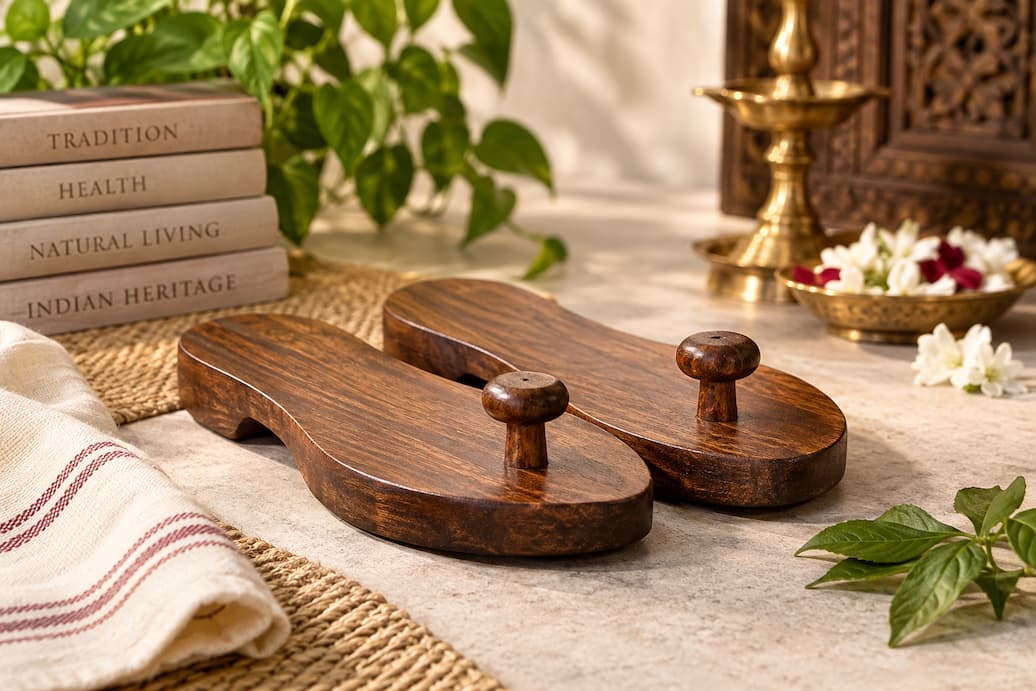

Choosing the right Khadau can be surprisingly personal. Two pairs may look similar at first glance, yet feel completely different once you consider the wood, weight, size, peg, sole, and way they are constructed. Traditional Khadau are also quite different from contemporary versions that are designed to make wooden footwear easier to wear in everyday life.
If you are buying Khadau for the first time, the best approach is not to simply look for the most attractive pair. Think about where you will wear them, how often you will use them, what kind of fit you prefer, and which traditional or modern features matter to you. This guide breaks down each of those choices so you can find a pair that suits both your feet and your purpose.
Start With How You Plan to Use Your Khadau
Before comparing woods or designs, decide what you actually want the Khadau for. The right pair for occasional traditional use may not be the same as the right pair for wearing around the house every day.
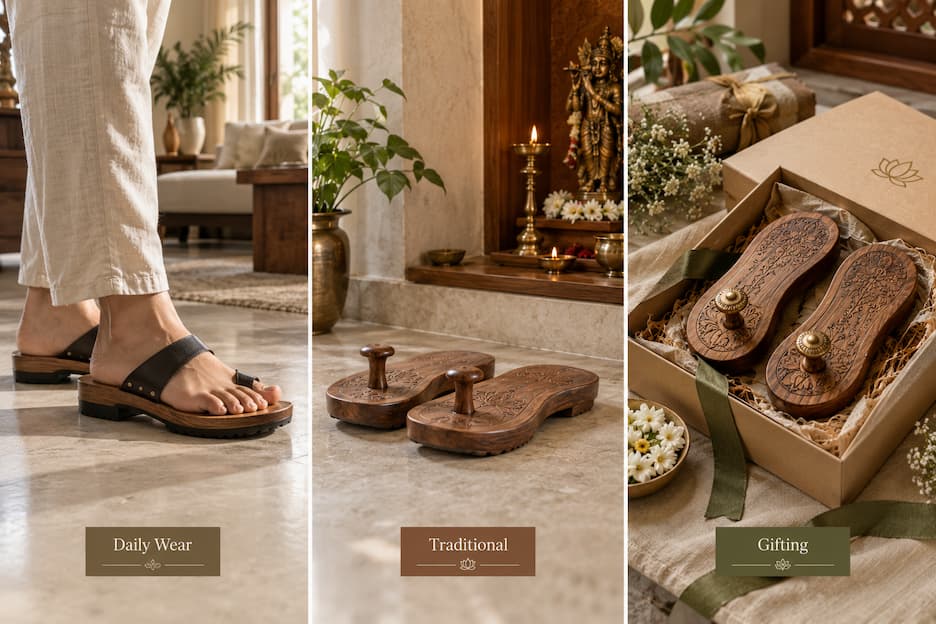
For daily home wear, comfort, manageable weight, secure foot placement, and good grip become particularly important. If you plan to use them outdoors, the sole and traction deserve even more attention.
For traditional or spiritual use, you may prefer a classic wooden base and traditional peg construction, where the character of the original Khadau is more important than modern adaptations.
For occasional wear or gifting, craftsmanship, appearance, and the quality of the wood may take priority over features designed for prolonged everyday use.
Having this purpose in mind makes the rest of the buying decision much easier.
Choose the Right Wood for Your Khadau
The wood is one of the first things to look at because it influences the character, weight, durability, and appearance of a Khadau. Different types of wood have traditionally been used for wooden footwear and Paduka, and each brings different qualities to the finished piece.
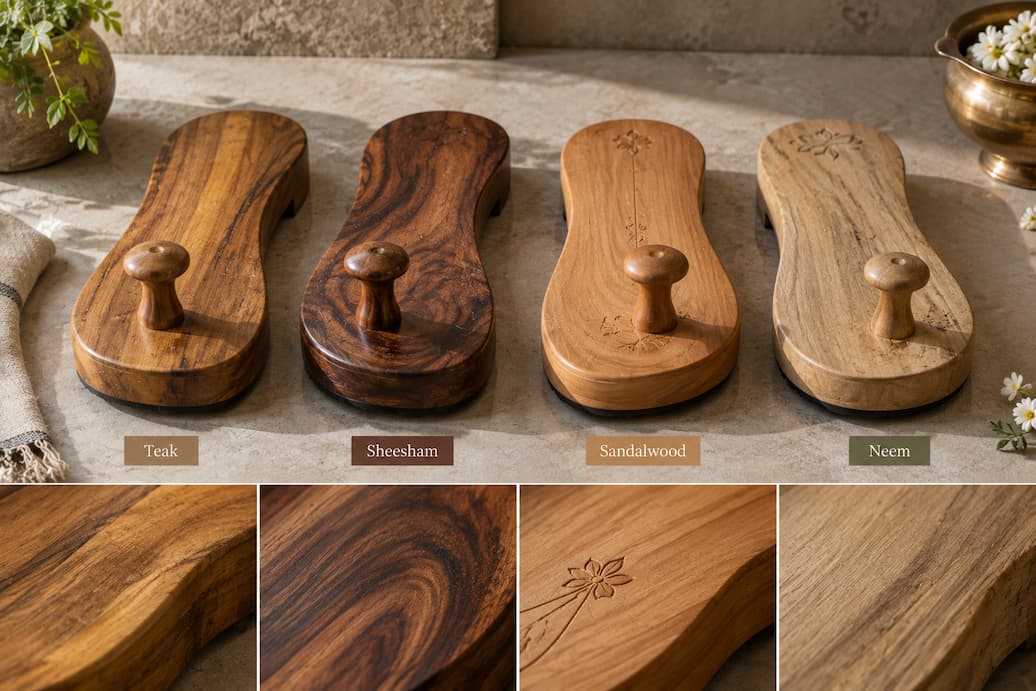
Teak
Teak is a dense, durable hardwood and can be a practical choice when you want a sturdy Khadau that can handle regular use. Its naturally distinctive grain also gives the footwear a substantial, traditional appearance.
Consider teak if: durability and a robust wooden base are your priorities.
Sheesham / Indian Rosewood
Sheesham is another dense hardwood known for its pronounced natural grain and rich appearance. A well-finished Sheesham Khadau can have a particularly attractive handcrafted character.
Consider Sheesham if: you value distinctive wood grain and a substantial hardwood feel.
Sandalwood
Sandalwood has a particularly strong cultural and traditional association with Indian wooden footwear and Paduka. Its natural fragrance and distinctive character make it especially appealing for ceremonial, spiritual or special-use pieces.
Consider sandalwood if: traditional character, fragrance and cultural significance matter more than everyday practicality.
Neem
Neem is another Indian wood that is used in wooden Khadau. It can be an interesting option if you prefer a traditionally associated Indian wood and a naturally simple appearance.
Consider neem if: you want a traditional Indian wood and find a well-crafted pair from a reliable maker.
So, Which Wood Should You Choose?
There isn’t one wood that is universally “best.” The quality of the actual Khadau matters just as much as the species of wood.
For regular use, prioritize durability, manageable weight, and good finishing. For traditional or special-purpose Khadau, the wood’s cultural character, grain, and fragrance may carry more importance.
Most importantly, look for properly finished wood without rough edges, splinters, or obvious construction problems.
Get the Right Khadau Size and Fit
Khadau sizing is slightly different from buying an ordinary pair of sandals. Since the foot interacts directly with the wooden base and the peg, getting the dimensions right is important.
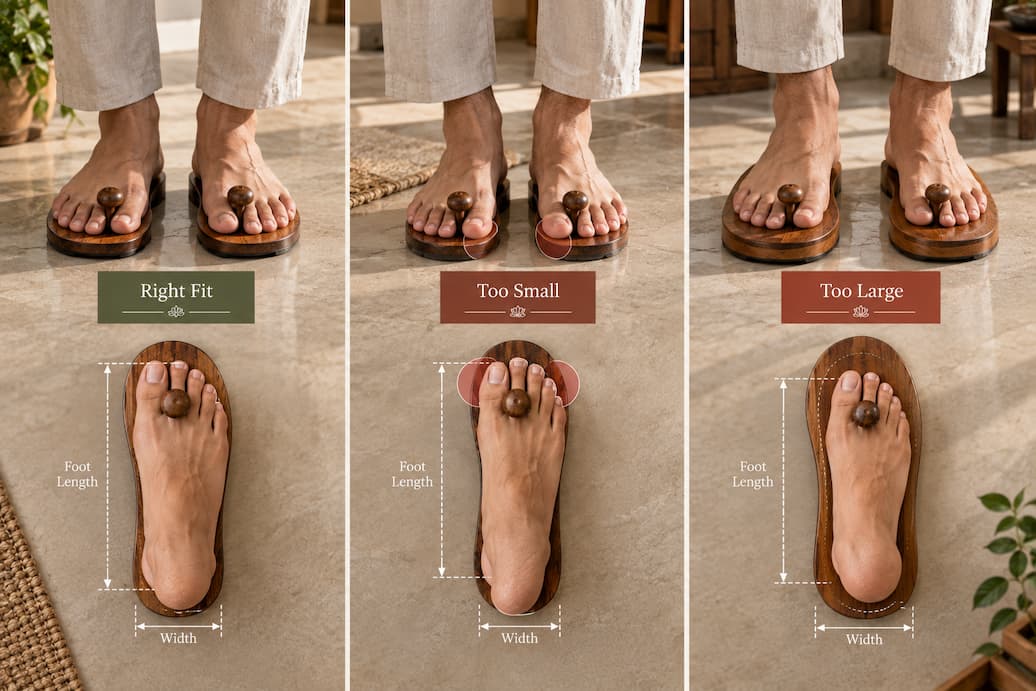
Start by measuring the length of your foot according to the seller’s instructions. Compare that measurement with the Khadau’s actual size chart rather than relying only on your usual shoe size.
Your foot should sit comfortably on the wooden base without excessive overhang at either end. At the same time, the Khadau should not be so large that you have to work unnecessarily hard to control it while walking.
Width matters too. If you have broad feet, check whether the wooden base provides enough surface area for your foot to sit naturally.
The toe position in relation to the peg is particularly important. Your toes should be able to rest around the peg without being cramped or forced into an unnatural position.
If you are between sizes, check the manufacturer’s recommendations and return or exchange policy before ordering.
Understand the Khadau Peg Before Buying
The peg is perhaps the most distinctive part of a traditional Khadau. Unlike conventional sandals, where a strap holds the foot in place, the peg sits between the toes and becomes the main point of contact between the foot and the wooden base.
That means its design matters.
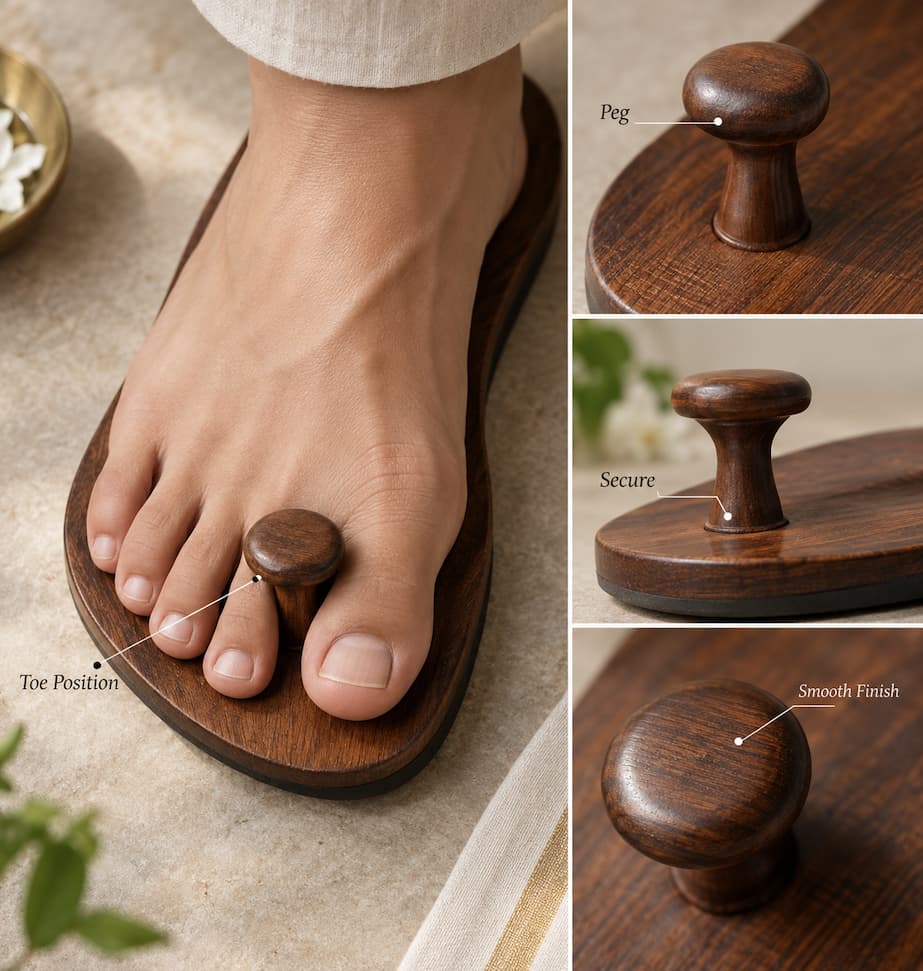
Look at the position, height, shape, and finish of the peg. It should be securely attached to the wooden base and smoothly finished so there are no rough edges that could cause discomfort.
For someone new to Khadau, the traditional peg can take some getting used to. A well-positioned peg and correctly sized base can make that learning period considerably easier.
If you are buying Khadau primarily for traditional use, you may want to stay with the classic peg construction. If you are looking for everyday footwear, you may find a modern design with additional foot support more convenient.
Choose the Right Sole for Where You Wear Them
A completely wooden sole gives Khadau their traditional character, but it is not necessarily the most practical option for every surface.
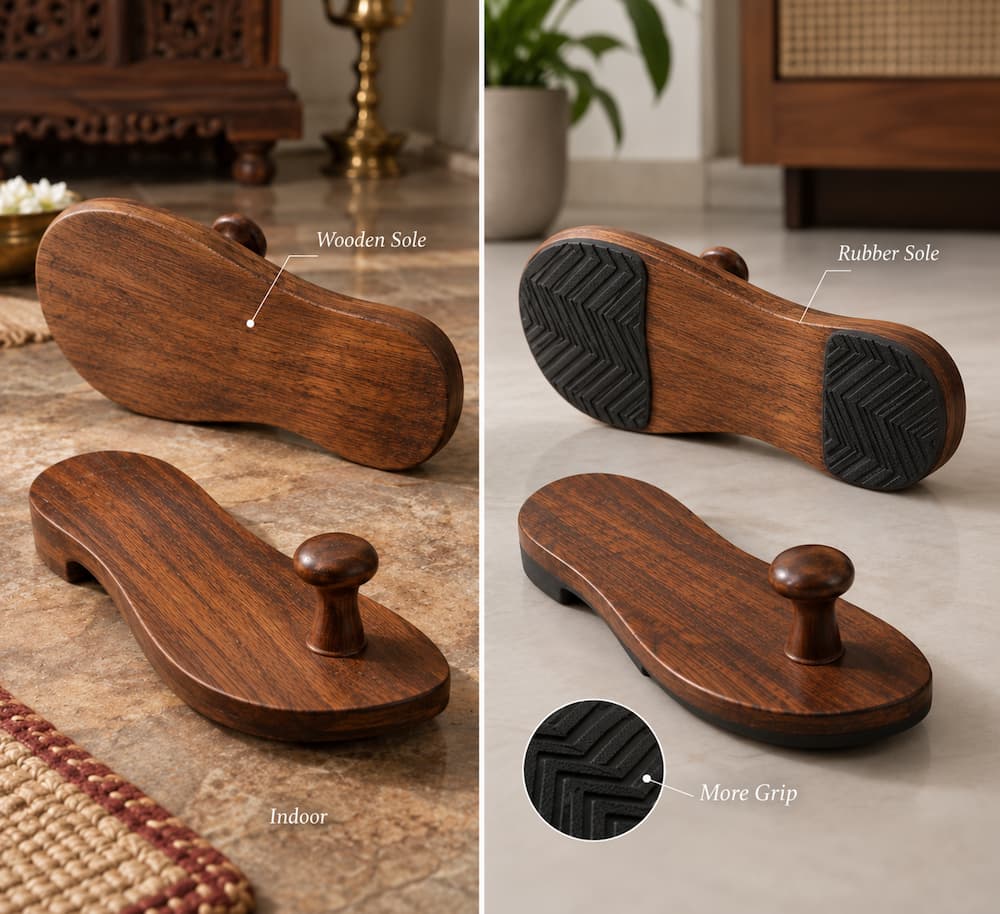
Traditional wooden soles can work particularly well for indoor or occasional use, especially if you appreciate the distinctive feel of walking on a wooden base.
Modern Khadau may incorporate a rubber sole or rubber layer beneath the wood. This can provide additional traction and make them more suitable for contemporary flooring or outdoor surfaces.
Think about your usual environment before choosing.
If you mostly wear Khadau inside a home with relatively suitable flooring, a traditional wooden base may be perfectly adequate. If you regularly move across polished stone, tiles or outdoor surfaces, additional grip can be a useful practical feature.
The important thing is that the sole should suit your intended use rather than simply looking traditional.
Traditional Peg or Straps: Which Should You Choose?
Modern Khadau have introduced another choice that traditional wearers did not have: how the footwear secures itself to the foot.
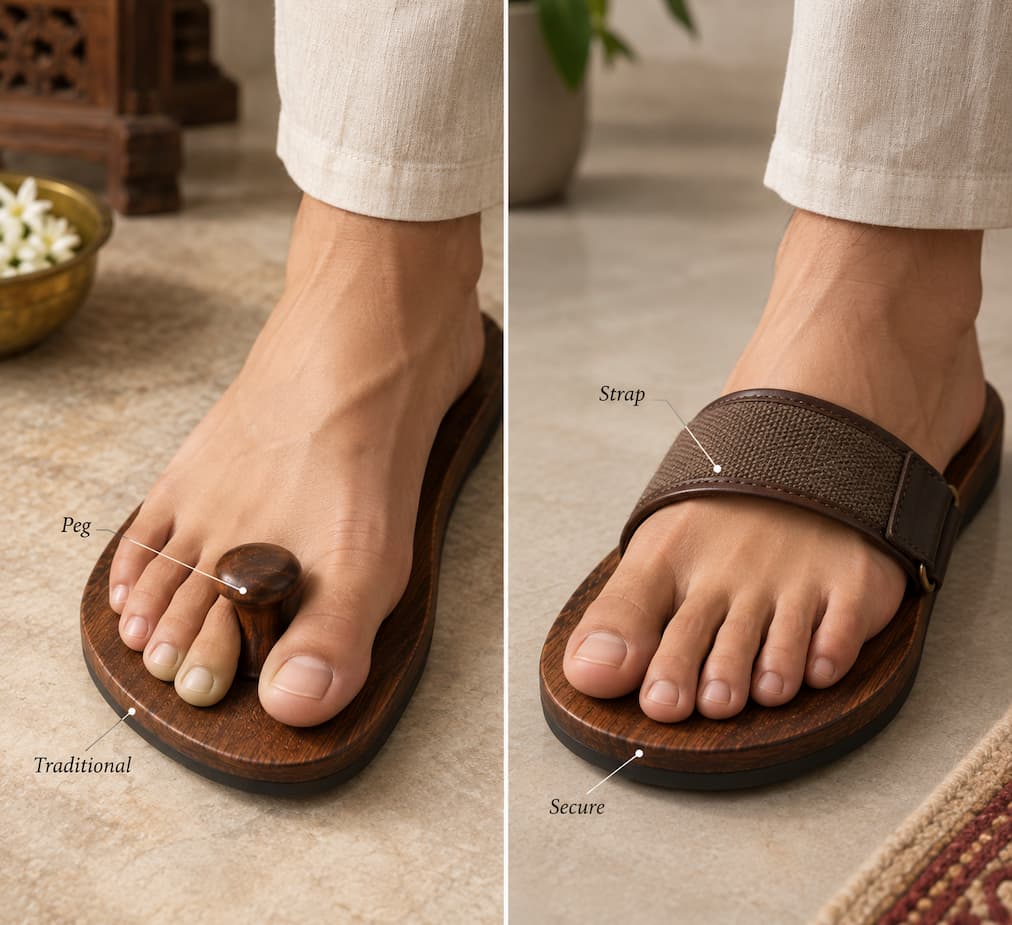
A traditional peg gives you the classic Khadau experience. It is simple, distinctive and closely associated with the traditional construction of wooden Paduka.
A rubber, leather or fabric strap, on the other hand, can provide a more familiar method of securing the foot. This can be useful for someone who wants the appearance and wooden character of Khadau without relying entirely on the traditional peg.
Neither construction is automatically better. Your choice should depend on what you want from the footwear.
Choose the peg if traditional construction and the original experience are your priority. Consider straps if you want additional foot security or are looking for something that feels easier to incorporate into everyday wear.
Traditional vs Modern Khadau: Which Is Right for You?
Modern Khadau do not necessarily abandon tradition. Instead, they often retain the wooden base while adapting certain features for contemporary use.
| Feature | Traditional Khadau | Modern Khadau |
|---|---|---|
| Wooden base | Yes | Yes |
| Foot support | Traditional peg | Peg and/or straps |
| Sole | Usually wooden | May include rubber |
| Grip | Depends on surface | Often enhanced |
| Character | Strongly traditional | Traditional with modern adaptations |
| Best suited for | Traditional/occasional use | Everyday contemporary use |
If you are particularly interested in the history and traditional construction of Khadau, a classic peg-and-wood design may be the obvious choice.
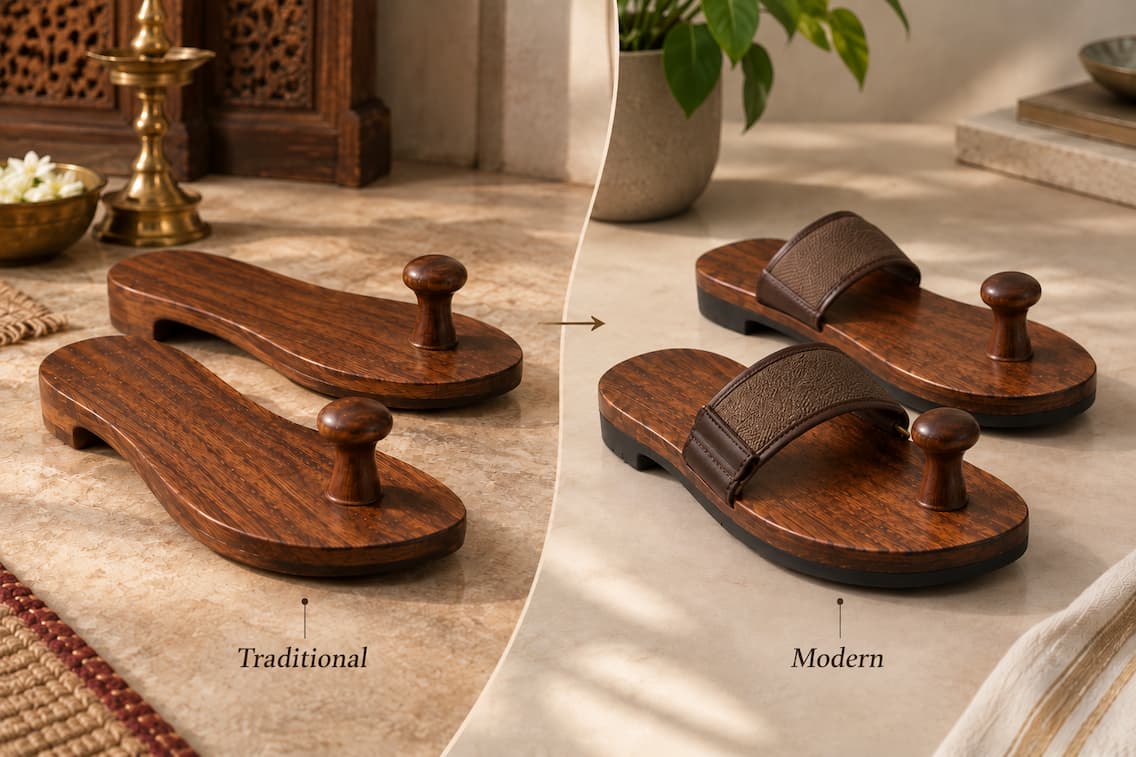
If you want to wear them regularly around a modern home or incorporate them into everyday life, features such as rubber straps and a rubber-enhanced sole can make a meaningful difference.
Check the Craftsmanship Before You Buy
Once you have narrowed down the material and construction, look closely at the actual craftsmanship.
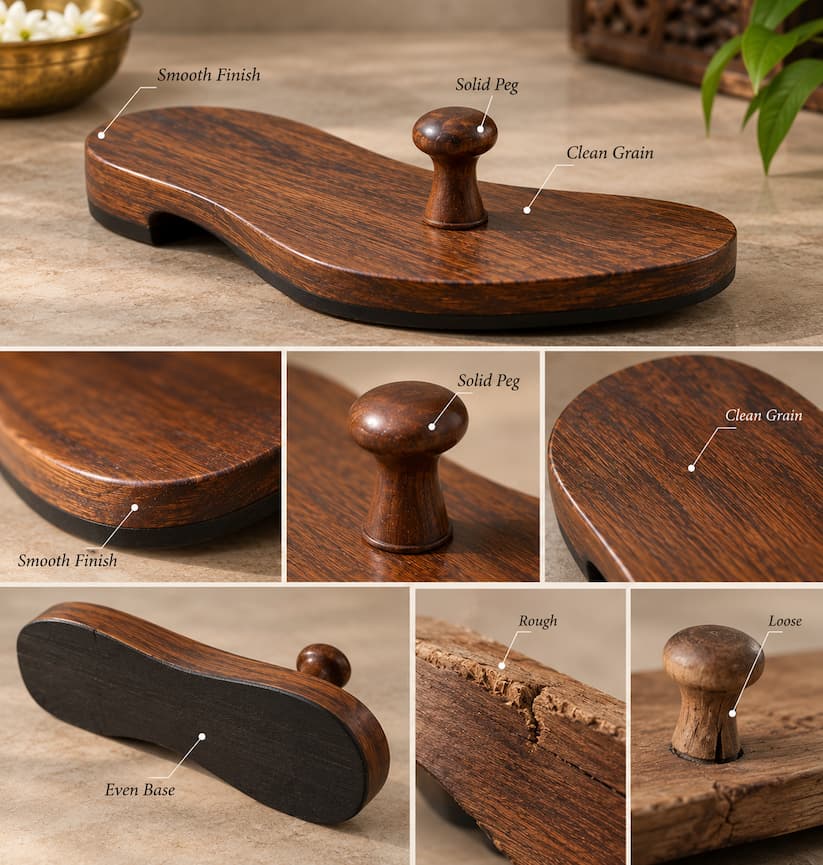
The wooden base should be smooth and properly finished, particularly around the edges and underside. Small natural variations in grain are expected with genuine wood, but rough surfaces, splinters, or poorly finished corners are different matters.
Check the peg or straps carefully. They should be firmly attached and should not appear loose or poorly fitted.
Look at the overall shape of the base as well. It should appear balanced and properly constructed rather than warped or uneven.
If buying online, don’t rely on a single product photograph. Look for images from multiple angles that allow you to inspect the wood grain, edges, peg, sole and overall construction.
Handcrafted Khadau can have slight variations because natural wood is not perfectly uniform. Those variations can actually be part of their character. What matters is that the finished product shows care and good workmanship.
Choose Khadau According to How You’ll Wear Them
Once you understand the construction, you can narrow down your choice based on your actual routine.
For Daily Home Wear
Prioritize a comfortable fit, manageable weight and secure foot placement. If your floors are smooth, a Khadau with additional grip can also be worth considering.

Khadau Chappal for Men Rubber Sole
As an Amazon Associate I earn from qualifying purchases.

Rosewood Handcrafted Vaidik Paduka Khadau Slippers with Straps
As an Amazon Associate I earn from qualifying purchases.

Traditional Indian Wooden Sandals
As an Amazon Associate I earn from qualifying purchases.
For Traditional or Spiritual Use
A classic wooden Khadau with traditional peg construction may be more appropriate when preserving the traditional character of the footwear is your main priority.

Wooden Khadau Paduka Sandals for Men & Women
As an Amazon Associate I earn from qualifying purchases.

Rosewood Handcrafted Wooden Khadau Paduka For Puja
As an Amazon Associate I earn from qualifying purchases.

Gau Shakti Handcrafted Wooden Khadau Paduka
As an Amazon Associate I earn from qualifying purchases.
For Outdoor Use
Pay particular attention to the sole and grip. A modern design with a rubber-enhanced sole may be more practical than a completely smooth wooden base.
Khadau Chappal for Men Rubber Sole
As an Amazon Associate I earn from qualifying purchases.

Wooden Khadau Slippers with Rubber Straps
As an Amazon Associate I earn from qualifying purchases.
For Occasional Wear
You can place more emphasis on craftsmanship, traditional appearance and the type of wood rather than features designed specifically for frequent everyday use.

Designer Carved Khadau Chappal for Men & Women
As an Amazon Associate I earn from qualifying purchases.

Sheesham Wood Khadau Paduka for Men & Women
As an Amazon Associate I earn from qualifying purchases.
Wooden Khadau Paduka Sandals for Men & Women
As an Amazon Associate I earn from qualifying purchases.
For Gifting
When buying Khadau as a gift, craftsmanship and presentation become important, but don’t overlook sizing. If you do not know the recipient’s exact foot measurements, check whether the seller offers size exchanges.

Sterling Silver Puja Item Lord Slipper (Khadau)
As an Amazon Associate I earn from qualifying purchases.
Designer Carved Khadau Chappal for Men & Women
As an Amazon Associate I earn from qualifying purchases.

Khadau for Men and Women, Unique Nobes Designs, White Fish Shape
As an Amazon Associate I earn from qualifying purchases.
Common Mistakes to Avoid When Buying Khadau
One of the biggest mistakes is choosing Khadau entirely on appearance. A beautiful wooden grain or elaborate design cannot compensate for an uncomfortable fit or a poorly constructed peg.
Another is assuming that your regular shoe size will automatically work. Khadau have a different construction, so checking the seller’s measurement chart is worth the extra few minutes.
Some buyers also overlook the weight. A substantial wooden Khadau can feel very different from a lighter pair, particularly if you intend to wear it regularly.
The sole is another commonly overlooked detail. A traditional wooden sole may be appropriate for your intended use, but it may not provide the same traction as a rubber-enhanced design on smooth modern flooring.
Finally, don’t assume that the most traditional Khadau is necessarily the best choice for everyone. Traditional construction and everyday practicality are different considerations, and the right balance depends on how you intend to wear them.
A Simple Khadau Buying Checklist
Before placing your order, run through these points:
- Size: Does the seller’s measurement chart match your foot measurements?
- Wood: Is the wood suitable for how frequently you plan to use the Khadau?
- Finish: Is the surface smooth and properly finished?
- Peg: Is it comfortable, well-positioned, and securely attached?
- Weight: Will the Khadau be manageable for your intended use?
- Sole: Does it provide appropriate grip for your usual surfaces?
- Straps: If included, are they secure and comfortable?
- Construction: Does the overall product look balanced and well-made?
- Purpose: Does the design actually suit how you plan to wear it?
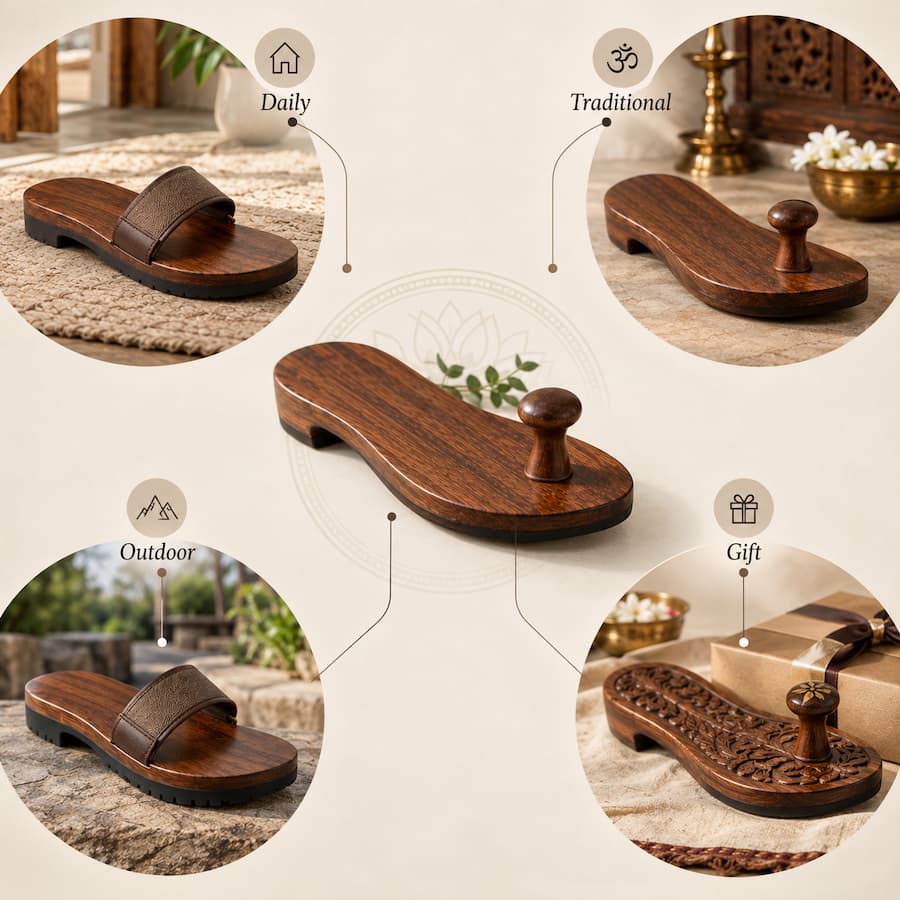
A good Khadau should make sense on this checklist before you even start thinking about whether you simply like its appearance.
Final Thoughts
The right Khadau is ultimately a balance between tradition, craftsmanship, fit, and practicality. The type of wood determines much of its character, while the size and peg influence how naturally it feels under your feet. The sole, straps, and overall construction become especially important when you want to wear Khadau regularly.
Rather than searching for a universally “best” Khadau, start with your own purpose. Decide whether you want a traditional pair, an everyday version, something for occasional use, or a thoughtful handcrafted gift. From there, choosing the right wood, size, and construction becomes a much simpler decision.
A well-made Khadau should not only look beautiful; it should also make sense for the way you intend to wear it.
Explore more with Vandanya!!
Frequently Asked Questions
Which wood is best for Khadau?
There is no single best wood for everyone. Teak and Sheesham can be good choices when durability and a substantial hardwood are priorities, while sandalwood has particular traditional and fragrant qualities. Neem is another traditionally used Indian wood. The quality and finishing of the actual Khadau are equally important.
Are wooden Khadau suitable for daily wear?
They can be, provided the size, weight, construction, and foot support suit you. Modern Khadau with features such as rubber straps or enhanced soles can be particularly practical for everyday use.
Are traditional Khadau better than modern Khadau?
Not necessarily. Traditional Khadau preserve the classic peg-and-wood construction, while modern versions may add features intended to improve grip, foot security, and everyday practicality. The better option depends on how you plan to use them.
Are Khadau difficult to walk in?
They can feel unfamiliar at first because the foot interacts with the wooden base and peg differently from conventional footwear. A properly sized pair with a comfortable peg can make the adjustment easier, and regular use can help you become accustomed to the movement.
What should I check when buying Khadau online?
Check the size chart, wood type, product dimensions, photographs of the construction, peg or strap attachment, sole design, finishing, and return policy. Product photographs from multiple angles are especially useful when assessing handmade wooden footwear.
Can I wear Khadau outdoors?
Yes, but the suitability depends on the construction and surface. If you plan to wear them outdoors regularly, look for a design with appropriate grip and a sole suited to the surfaces you expect to walk on.