This Website Is Still Under Development! So Some Things Might Not Work
We are creating something AWESOME!!!

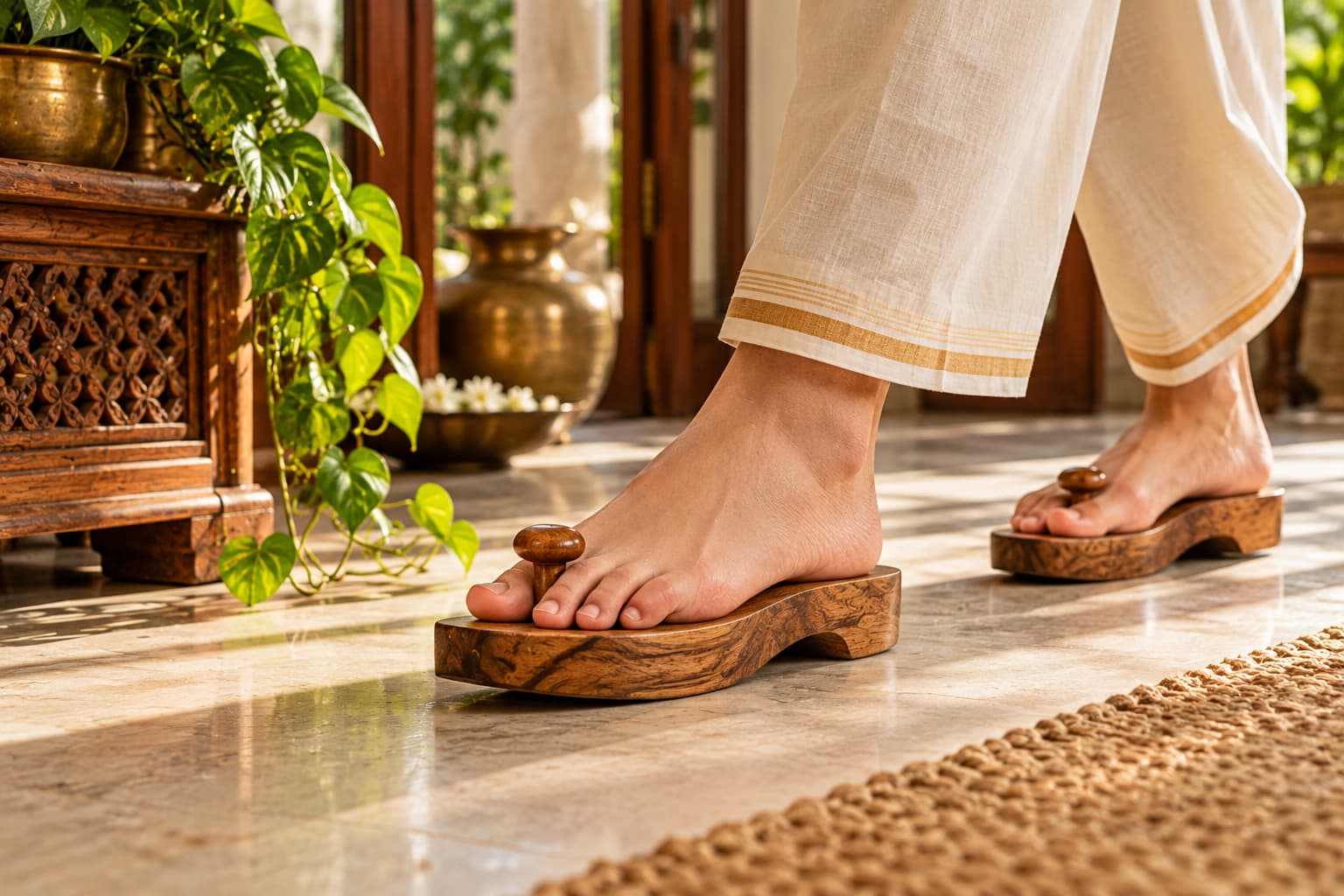

Wearing Khadau comfortably is mostly a matter of getting the fit right, positioning your foot correctly and giving yourself time to adjust to the traditional toe-peg design. Unlike regular sandals, Khadau do not hold the foot with a conventional upper strap. Your foot rests on a wooden base and is guided by a peg positioned between the toes, so the walking experience is different from modern footwear.
That difference does not necessarily make Khadau uncomfortable. A properly sized pair with a smooth peg, balanced wooden base and suitable sole can become much easier to wear once you understand how to use them.
If you are wearing Khadau for the first time, don’t expect them to feel exactly like your regular sandals on day one. The goal is to learn how to place your foot, take shorter steps and gradually build familiarity rather than forcing yourself to walk normally immediately.
This guide explains how to wear Khadau comfortably, what beginners commonly get wrong, how to choose a suitable pair and how to make traditional wooden Khadau more practical for everyday use.
Quick Takeaways
- Choose the correct Khadau size rather than relying only on your regular shoe size.
- Your foot should sit naturally on the wooden base without excessive overhang.
- The toe peg should sit comfortably between the big toe and second toe without creating excessive pressure.
- Start by wearing Khadau for short periods around the home.
- Take controlled, shorter steps while learning to walk in them.
- Keep your foot relaxed rather than gripping the peg tightly with your toes.
- A smooth, properly finished wooden base and peg are important for comfort.
- Rubber soles or straps can make some modern Khadau more practical for everyday use.
- Don’t continue wearing a pair that causes persistent pain, rubbing or instability.
- Traditional Khadau may feel different from modern footwear, but the adjustment becomes easier with practice.
Why Does Khadau Feel Different From Regular Footwear?
The first thing to understand is that Khadau are built around a completely different way of securing the foot.
A conventional sandal usually uses a strap across the foot. Your foot can therefore move forward and backward within the limits of that strap while the sole stays underneath it.
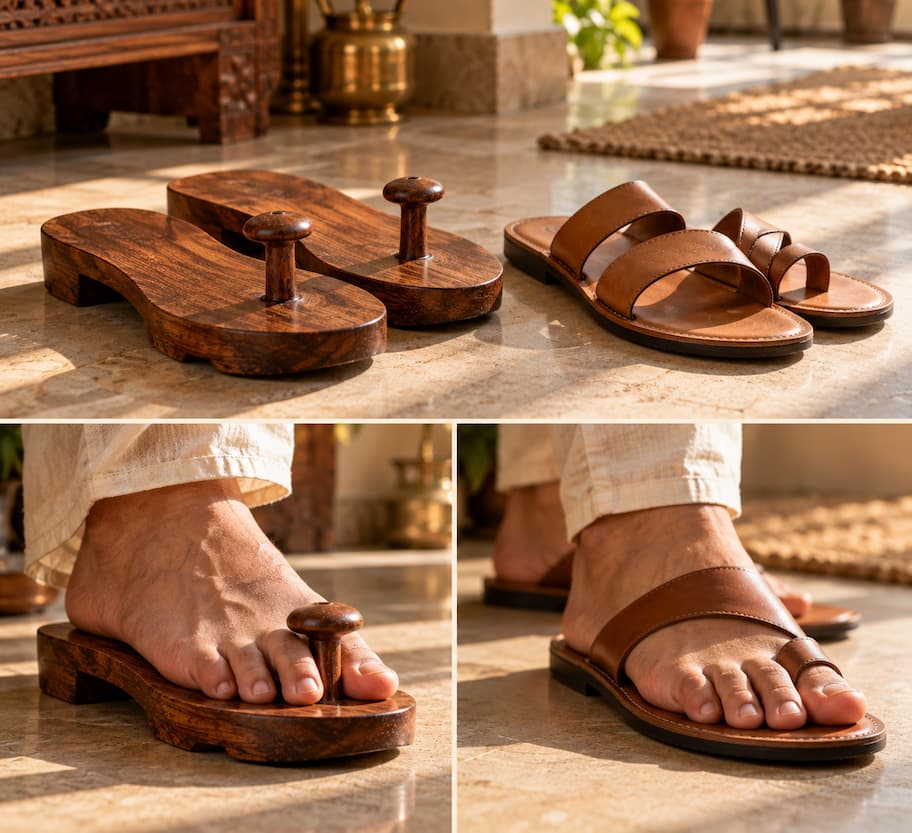
Traditional Khadau use a wooden base and a toe peg. The peg sits between the first and second toes and gives the foot a point of contact with the footwear. Instead of having a strap holding the front of your foot down, you learn to control the wooden base through the position of your foot and the peg.
That is why simply putting on a pair and walking exactly as you would in sneakers or sandals can feel awkward.
The adjustment is partly about balance and movement, not just softness or cushioning.
Khadau are also traditionally associated with Indian spiritual and cultural practices. If you’re interested in why this distinctive form of footwear has remained culturally significant, you can read more about the spiritual meaning of Khadau.
1) Start With the Right Khadau Size
Comfort starts before you take your first step.
One of the biggest mistakes beginners make is choosing Khadau based purely on their usual footwear size. Different manufacturers can use different sizing systems, and Khadau have a very different shape from conventional shoes.
Instead, measure your foot and compare it with the seller’s size chart.
Your foot should sit comfortably on the wooden base without being squeezed from the sides or hanging excessively over the front and back.
Look for these signs of a good fit:
- Your foot sits naturally on the base.
- Your toes aren’t forced into an awkward position.
- The heel isn’t hanging far beyond the wooden platform.
- The wooden edges don’t press into the sides of your foot.
- The toe peg sits in a natural position.
- You can lift and control the Khadau without excessive effort.
A little space around the foot is normal. What you want to avoid is excessive overhang or a base that is so large that controlling it becomes difficult.
If you’re still deciding what type of Khadau to buy, our guide on how to choose the right Khadau goes into more detail on size, wood, peg design, soles and different use cases.
2) Position Your Foot Correctly on the Khadau
Once you have the right size, foot placement becomes important.
Place your foot so that the toe peg sits naturally between the big toe and second toe. Your heel should rest comfortably toward the back of the wooden base without being forced against the edge.
Don’t immediately try to grip the peg aggressively with your toes.
The peg is there to help control the Khadau, but excessive gripping can make your toes tense and make the experience more uncomfortable.
Instead, keep your foot relatively relaxed and allow the sole of your foot to remain in contact with the wooden base.
Think of the movement as controlling the Khadau rather than clinging to it.
3) Start Walking Slowly
The easiest way to make Khadau uncomfortable is to rush.
If you’re wearing them for the first time, start indoors on a relatively even, dry surface.
Take short, controlled steps.
You don’t need to lift your feet very high. Instead, focus on keeping the wooden base relatively stable as your foot moves.
Initially, you may notice the sound of the wooden base contacting the floor. You may also feel that your stride is different from normal footwear.
That’s completely expected.
Give yourself time to understand how much movement is needed to keep the Khadau under your foot.
A simple progression for beginners
First few minutes:
Stand and take a few slow steps.
Next few sessions:
Walk around one room for a short period.
After you become comfortable:
Use them for longer periods around the house.
Only then:
Consider using them for more extensive walking, depending on the construction and sole of your pair.
The exact adjustment period will vary from person to person.
4) Take Shorter Steps at First
Your normal walking stride may feel too large when you first wear Khadau.
Shorter steps give you more control over the wooden base and reduce the amount of movement you need to manage.
As you become familiar with the footwear, your stride can naturally become more comfortable.
This is particularly useful when you’re wearing traditional peg-style Khadau, because there is no conventional strap holding the foot in place.
Don’t focus on making your walking style look completely normal immediately.
Focus on:
Balance → control → relaxed movement → longer strides
rather than trying to skip the adjustment process.
5) Keep Your Toes Relaxed
One of the most common beginner mistakes is gripping the peg too tightly.
It can feel instinctive to curl your toes around the peg because you don’t yet trust the Khadau to stay under your foot.
But constantly tensing your toes can make your feet tired.
Instead, allow the toe peg to sit naturally between your toes and use your foot position to control the wooden base.
If you find yourself repeatedly clenching your toes, stop for a moment and reset your foot position.
The goal is not to hold the Khadau with maximum force. It’s to develop enough control that the footwear moves naturally with your foot.
6) Practice on the Right Surface
Where you practise matters.
A clean, dry, relatively even indoor floor is a better starting point than a busy outdoor environment.
Avoid learning to walk in Khadau on:
- Wet floors
- Uneven ground
- Loose gravel
- Steep slopes
- Highly slippery surfaces
- Crowded areas
You want to remove unnecessary variables while you’re still learning.
Once you are comfortable indoors, you can decide whether your particular Khadau are suitable for other surfaces.
This is particularly important because traditional wooden soles and modern rubber-enhanced soles can behave very differently.
7) Choose the Right Sole for Comfort and Grip
Traditional Khadau typically retain their wooden base, but contemporary versions can include rubber soles or rubber-enhanced sections.
This can change how the footwear feels on modern flooring.
If you mainly wear Khadau inside a home with relatively suitable flooring, a traditional wooden sole may work perfectly well for you.
If you regularly walk across smoother surfaces, you may prefer a modern design with additional grip.
The important thing is not to assume that one construction is automatically better.
Choose according to where you actually intend to wear them.
8) Consider a Strap if You Are New to Khadau
Not every modern Khadau relies exclusively on the traditional peg.
Some contemporary designs use rubber, leather or fabric straps alongside a wooden base. These can provide additional foot security and may feel more familiar to someone accustomed to modern sandals.
There is no need to view this as a choice between “real” Khadau and “fake” Khadau.
The traditional peg is an important part of classic Khadau construction, but modern adaptations can make wooden footwear more practical for people who want to use it regularly.
Traditional peg
Best if you want:
- Classic construction
- Traditional experience
- Minimalist design
- Cultural authenticity
Strap-based design
May be preferable if you want:
- Additional foot security
- Easier everyday use
- A more familiar sandal-like feel
- Contemporary construction
9) Don’t Start With Long Walks
If you have never worn Khadau before, there is little reason to start with a long walk.
Your feet need to become familiar with:
- The wooden base
- The toe peg
- The weight
- The movement
- The balance
- The way the footwear contacts the floor
Start with short periods around your home.
If your feet feel comfortable, gradually increase the duration.
If you experience persistent pain, significant rubbing or instability, stop and reassess the fit and construction instead of simply trying to “push through” the discomfort.
10) Wear Khadau Around the House First
For beginners, home use is probably the simplest place to start.
The environment is familiar, the distances are short and you can take the Khadau off whenever you need to.
You can begin with simple activities such as:
- Walking between rooms
- Standing briefly
- Moving around the living room
- Using them while doing light household tasks
This gives you time to develop control without the pressure of navigating unfamiliar terrain.
It also lets you determine whether the particular pair you bought is actually suitable for regular use.
11) Make Sure the Peg Is Smooth
The toe peg is one of the most important parts of a traditional Khadau.
Before wearing a pair regularly, inspect it carefully.
The peg should be:
- Smoothly finished
- Securely attached
- Free from sharp edges
- Comfortable between the toes
- Properly positioned
A poorly finished peg can cause unnecessary rubbing or irritation, even when the overall Khadau is otherwise well made.
The same applies to the wooden base. Rough edges and unfinished sections should not simply be ignored because the product looks attractive.
12) Check the Wooden Base
Run your hand carefully over the wooden surface before wearing the Khadau.
Look for:
- Splinters
- Sharp corners
- Cracks
- Uneven finishing
- Loose components
- Excessively rough surfaces
Natural wood grain and small variations are not necessarily defects. In handcrafted footwear, variation can be part of the character of the material.
What matters is whether the surface is properly finished and structurally sound.
A beautiful grain pattern does not compensate for poor construction.
13) Choose a Manageable Weight
Khadau are wooden footwear, so they naturally have more structure than many modern sandals.
But there can still be significant differences between pairs.
A thick, dense wooden Khadau may feel substantial, while a lighter construction may be easier to control during everyday indoor use.
If you are a beginner, consider choosing a pair that feels manageable rather than unnecessarily heavy.
Weight becomes particularly noticeable when you are taking repeated steps over a longer period.
This is one of the reasons choosing Khadau based solely on appearance can be a mistake.
Can Khadau Be Comfortable for Daily Use?
Yes, but comfort depends heavily on the individual design and the wearer.
A well-fitted Khadau with a smooth wooden base, suitable peg position, manageable weight and appropriate sole can be practical for everyday home use.
Modern Khadau with straps or rubber-enhanced soles can provide additional practicality where traditional construction may feel less familiar.
However, it’s important not to make broad claims that all wooden Khadau are comfortable or that wearing them provides guaranteed health benefits.
The experience varies between people.
If you’re interested in the traditional and commonly discussed health aspects of Khadau, our article on how wooden Khadau may benefit health explores those claims in more detail while separating traditional beliefs from practical considerations.
Traditional Khadau vs Modern Khadau for Comfort
The question isn’t necessarily whether traditional or modern Khadau are better.
It’s better for what?
| Feature | Traditional Khadau | Modern Khadau |
|---|---|---|
| Wooden base | Yes | Usually |
| Toe peg | Usually | May be included |
| Strap | Usually absent | May be included |
| Rubber sole | Usually absent | May be included |
| Foot security | Requires adjustment | Can be easier |
| Traditional feel | Strong | Varies |
| Everyday practicality | Depends on design | Often adapted for it |
| Beginner-friendly | Requires adjustment | May be easier |
If your priority is experiencing traditional Khadau as they have historically been worn, a classic peg design may be more appropriate.
If your priority is regular home wear and easier foot security, a contemporary design may make more sense.
How to Make Khadau More Comfortable Over Time
Comfort doesn’t necessarily come from changing the footwear.
It can also come from becoming familiar with it.
Wear them regularly but briefly
Short sessions help you learn the movement without unnecessarily tiring your feet.
Keep your movements controlled
Avoid suddenly trying to walk quickly or take unusually large steps.
Maintain the wooden surface
Keep the Khadau clean and inspect them periodically.
Check the peg
A loose or damaged peg should not be ignored.
Match them to the right environment
A pair designed for indoor use doesn’t automatically become appropriate for long outdoor walks.
Replace them when the construction is compromised
Cracks, loose pegs or damaged straps are reasons to reconsider continued use.
Can You Wear Khadau With Traditional or Everyday Clothing?
Absolutely, one reason modern Khadau have become interesting beyond strictly religious or ceremonial settings is their ability to work with different styles of clothing.
Traditional wooden Khadau can naturally complement:
- Kurta-pajamas
- Dhoti
- Cotton Indian clothing
- Handloom outfits
- Simple traditional wear
Modern strap-based Khadau can also work with:
- Linen trousers
- Cotton pants
- Relaxed everyday clothing
- Minimal Indian-inspired outfits
The footwear does not have to be treated as a costume piece.
A simple handcrafted wooden Khadau can work as part of an understated everyday look.
Common Mistakes Beginners Make
- Trying to Walk Normally Immediately; Khadau have a different construction, so your movement may need some adjustment.
- Choosing Your Normal Shoe Size; Always check the seller’s measurements.
- Gripping the Peg Too Hard; Excessive toe tension can make your feet tired.
- Starting With Long Walks; Give yourself time to adjust.
- Ignoring the Sole; Think about the surfaces where you’ll actually use them.
- Buying Based Only on Appearance; Craftsmanship, fit and construction matter more than decorative details.
- Ignoring Rough Wood; A poorly finished surface can create unnecessary discomfort.
- Assuming Traditional Means Automatically Better; Traditional construction may be exactly what you want, but modern adaptations can be useful for everyday wear.
A Simple Beginner Routine for Wearing Khadau
If you’ve just bought your first pair, try this approach.
Day 1: Get Familiar
Put them on while standing. Adjust your foot position and take a few slow steps.
Day 2–3: Walk Indoors
Use them for short periods around one room or your home.
Next Few Sessions: Increase Gradually
Once the movement feels more natural, extend the amount of time you wear them.
After You Adjust
Decide whether the pair is comfortable enough for your intended use.
There’s no requirement to reach a particular duration. If your intended use is simply walking around the house for a few minutes at a time, there’s no reason to train yourself for long-distance walking.
How to Know You’ve Chosen the Right Khadau
A suitable pair should feel increasingly natural as you become accustomed to it.
You should be able to:
- Place your foot comfortably on the base.
- Keep the toe peg in a natural position.
- Walk without constantly gripping with your toes.
- Control the wooden base without excessive effort.
- Move around without persistent rubbing.
- Use the pair for the amount of time appropriate to your routine.
If all of these are happening, you’re probably on the right track.
And if you’re still shopping rather than learning to walk in a pair, go back to the fundamentals: purpose, size, wood, peg, sole, straps and craftsmanship.
Final Thoughts
Learning how to wear Khadau comfortably is less about forcing traditional footwear to behave like modern sandals and more about understanding how Khadau are designed to work.
Start with the right size. Place your foot naturally around the toe peg. Keep your toes relaxed, take shorter steps and practise indoors before attempting longer walks. Pay attention to the finish of the wood, the position of the peg, the weight of the pair and the type of sole underneath.
If you want the classic experience, traditional peg-style Khadau can provide it. If you want something easier to incorporate into everyday life, modern designs with straps or rubber-enhanced soles can offer a useful alternative.
Most importantly, comfort should not be treated as something you have to endure. A little unfamiliarity is part of learning to wear Khadau, but persistent pain, rubbing or instability is a reason to reassess the fit or construction.
Khadau have a distinctive place in Indian footwear and culture. Wearing them comfortably simply requires giving your feet enough time to understand a design that is very different from the footwear most of us use today.
Frequently Asked Questions
How long does it take to get used to Khadau?
There is no fixed adjustment period. Some people may become comfortable quickly, while others need several short sessions. Starting gradually is generally easier than wearing them for a long period immediately.
How should your toes sit in Khadau?
The toe peg should sit naturally between the big toe and second toe. Avoid excessive gripping or curling of the toes around the peg.
Should Khadau be tight?
No. The foot should feel secure without being squeezed. The wooden base should provide enough room for your foot to sit naturally, while the peg provides the primary point of control in traditional designs.
Can I wear Khadau every day?
Yes, if the particular pair fits well and is suitable for your intended environment. Modern Khadau with straps or rubber-enhanced soles can be particularly practical for regular home use.
Are Khadau good for beginners?
They can be, but beginners should expect an adjustment period. A properly sized pair with a smooth peg and manageable weight is a better starting point than choosing solely based on appearance.
Can I wear Khadau outdoors?
Some Khadau can be used outdoors, but suitability depends on the sole, grip, construction and surface. A pair designed primarily for indoor use should not automatically be assumed to be appropriate for extensive outdoor walking.
Why does my Khadau hurt between my toes?
The peg may be poorly positioned, too large, rough or simply unsuitable for your foot. Excessive toe gripping can also contribute to discomfort. Check the fit and construction before continuing to wear them.
Can I wear Khadau with straps?
Yes. Contemporary Khadau designs may combine the traditional wooden base with rubber, leather or fabric straps. These can provide additional foot security and may be easier for everyday users.